
The Cost That Starts After You Get the Keys: Building a Real Monthly Home-Ownership Budget

Table of Contents
- Introduction
- Quick Answer: Use a Monthly Equivalent Ownership Cost, Not Just the EMI
- 1. First Separate Move-In Spending From Ownership Spending
- 2. Bucket 1: Fixed Monthly Community Costs
- 3. Bucket 2: Utilities That Move With Your Lifestyle
- 4. Bucket 3: Annual Bills You Should Divide by 12
- 5. Bucket 4: The Lifecycle Reserve Most Budgets Forget
- 6. Bucket 5: Personal Services Are Lifestyle Costs, Not Property Costs
- 7. Bucket 6: Keep an Ownership Contingency Reserve
- 8. The 12-Month Home-Ownership Budget Board
- 9. The First 90 Days: Calibrate Instead of Guessing
- 10. How to Use the Budget When Comparing a Villa in Phulnakhara
- Conclusion: A Home Can Fit the Purchase Budget and Still Miss the Monthly Budget
- FAQ
Introduction
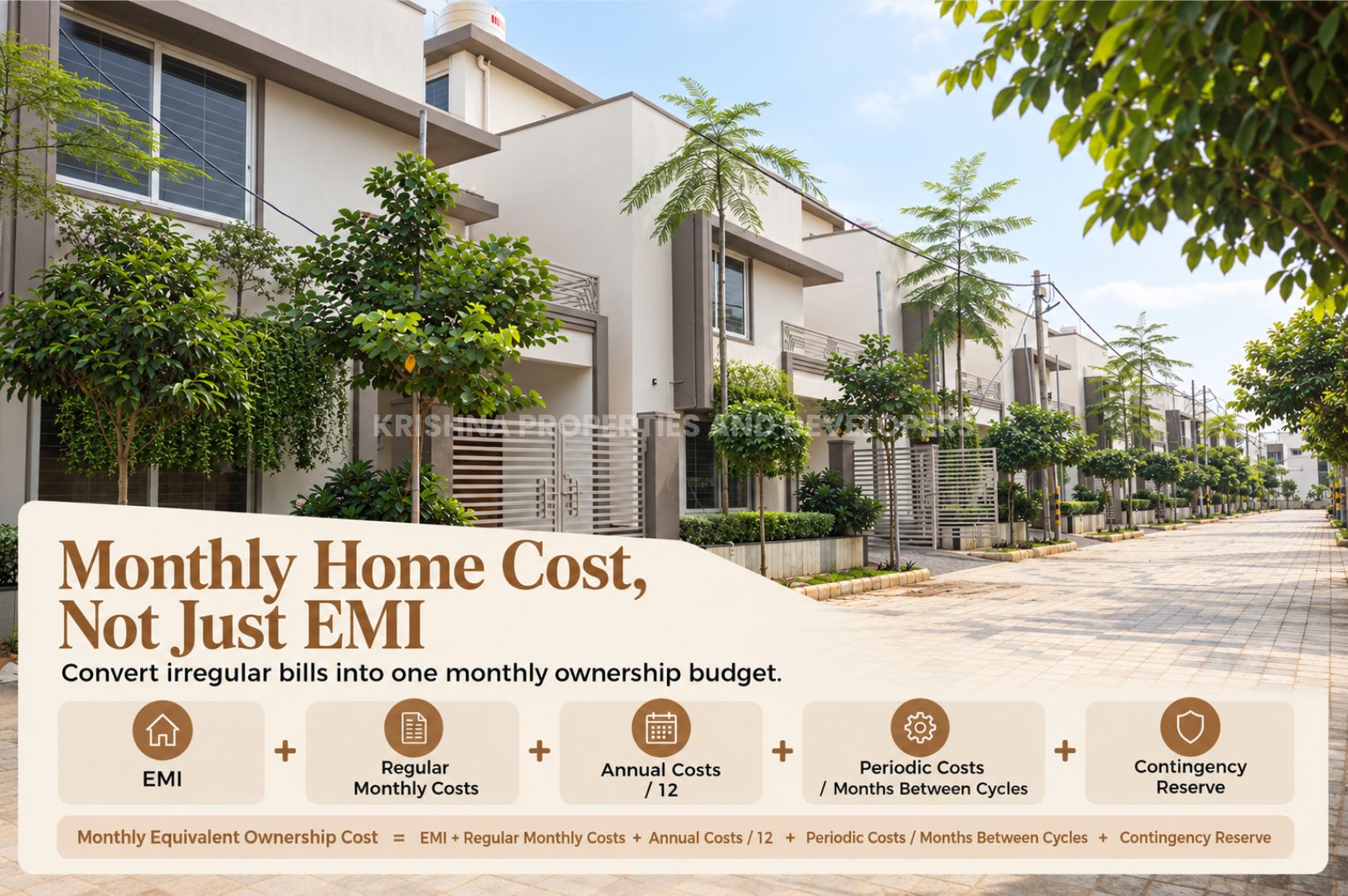
Quick Answer: Use a Monthly Equivalent Ownership Cost, Not Just the EMI
Build your budget with one formula:
TRUE MONTHLY HOME COST = EMI + REGULAR MONTHLY COSTS + ANNUAL COSTS / 12 + PERIODIC COSTS / MONTHS BETWEEN CYCLES + CONTINGENCY RESERVE
This method converts bills that arrive at different times into a single monthly home ownership budget. It also prevents a common mistake: treating repainting, waterproofing, appliance replacement or annual tax as “unexpected” simply because they do not arrive every month.
1. First Separate Move-In Spending From Ownership Spending
The first month after possession is unusually expensive. Curtains, appliances, furniture, grills, extra electrical work, movers, internet installation, cleaning and small personal upgrades can make the first statement look alarming. Those are move-in costs, not necessarily your recurring monthly ownership cost.
Create two ledgers from day one:
- MOVE-IN / ONE-TIME: furniture, appliances, initial installations, personal upgrades, relocation.
- OWNERSHIP / RECURRING: maintenance, utilities, tax, insurance, servicing, repairs and long-term reserves.
If you mix the two, you may conclude that the house is unaffordable during month one and then underestimate it during months two to twelve. A clean budget needs both categories, but it should not confuse them.

2. Bucket 1: Fixed Monthly Community Costs
For a home inside a managed community, begin with the written maintenance charge or common-service schedule. Do not assume the word “maintenance” covers everything.
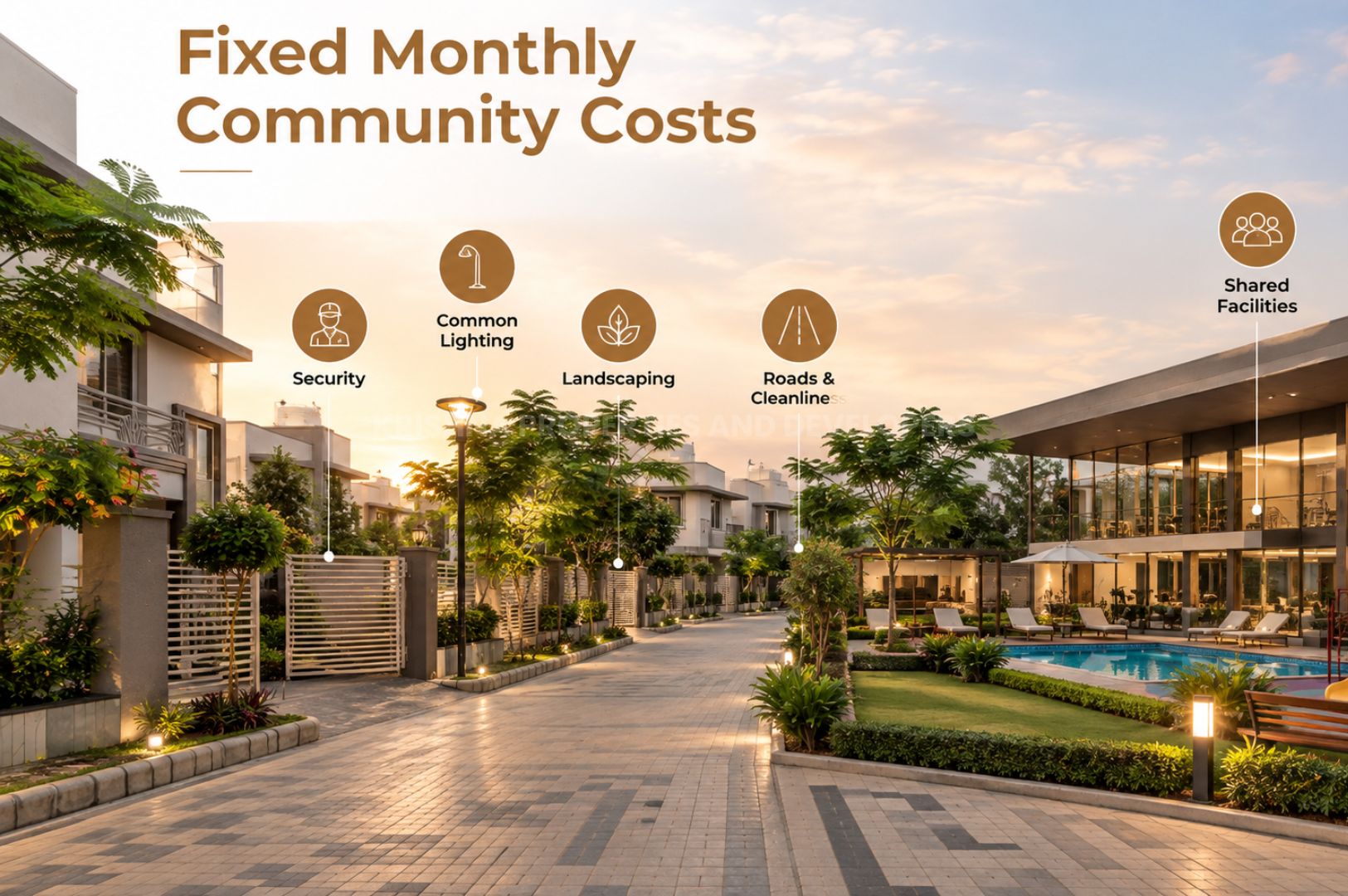
- Ask what the charge includes: security, common lighting, landscaping, roads, waste handling, clubhouse or shared-facility operations where applicable.
- Ask what is billed separately: backup power, water, facility bookings, consumption-based services or special repairs, where applicable.
- Ask how often the charge can be revised and who approves changes after handover.
- Ask whether there is a separate sinking/capital-repair fund or whether major common works are collected when needed.
This is also where the article intentionally differs from a future villa maintenance cost guide. Here, maintenance is one line in the household budget. The detailed question of what a villa needs to service, repair and repaint over time deserves its own article.
3. Bucket 2: Utilities That Move With Your Lifestyle
Utilities are not fixed property costs. They are behaviour-sensitive costs. Two identical homes can produce very different bills depending on occupancy, air-conditioning, work-from-home schedules, water systems, appliances and travel patterns.
Electricity: Budget by Season, Not by One “Average Month”
Odisha Electricity Regulatory Commission publishes the retail tariff framework for the state’s distribution companies for FY 2026-27. Actual household bills depend on the applicable consumer category, consumption and other tariff components. That is why a buyer should not copy a random “monthly electricity cost” from a real-estate blog.
Use three scenarios instead:
- BASE MONTH: mild-weather month with normal lighting, appliances and water systems.
- PEAK-COOLING MONTH: higher AC/fan use and longer indoor occupancy.
- LOW-OCCUPANCY MONTH: travel or reduced household use.
After three to six occupied months, replace estimates with your own bills. Until then, ask for the tariff category and use the official OERC framework rather than a generic rupee figure.
Water, Pumps and Treatment
Your water cost may appear small on a direct bill while still creating electricity and servicing costs through pumps, purification systems, storage cleaning or other equipment. A useful budget therefore links the water system to the residential water system you actually own or share.
If your property has an RO purifier, pump, softener, filter or other treatment system, put filter replacement and servicing in the budget separately instead of burying them under “miscellaneous.”
Internet, Cooking Fuel and Digital Services
Broadband, mobile backup, cooking fuel and entertainment subscriptions are not real-estate costs in the strict sense, but they are part of the monthly cost of living in the home. If you are comparing whether a new home fits the household budget, include them. If you are comparing one property against another, separate costs that would exist wherever you lived.
4. Bucket 3: Annual Bills You Should Divide by 12
Some ownership costs feel harmless because they arrive only once or twice a year. That is exactly why they should be converted into a monthly equivalent.
Property / Holding Tax
Bhubaneswar Municipal Corporation provides a public Property & Holding Tax service for properties within its jurisdiction. A home marketed as being near Bhubaneswar should not automatically be assumed to fall under BMC, so verify the actual local authority for the property before budgeting tax.
Budgeting rule: take the latest verified annual demand for your property and divide it by 12. Do not estimate tax as a percentage of the purchase price unless the relevant authority actually uses that method for your property.
Home / Property Insurance
IRDAI explains that property insurance can cover different risks depending on the policy – including fire and allied perils, burglary and householder-package risks. Premiums depend on the policy, sum insured, structure/contents and coverage chosen.
If you purchase cover, divide the annual premium by 12 and include it in your monthly ownership number. Keep the policy details separate from your loan paperwork so you know exactly what is insured and what is excluded.
Annual Service Contracts and Renewals
Some homes accumulate a surprising number of annual renewals: AC service plans, pest control, purifier servicing, inverter/battery checks, security-system support or garden equipment. List only what your home actually has. Then convert each renewal into a monthly reserve.
5. Bucket 4: The Lifecycle Reserve Most Budgets Forget
This is the category that turns a basic expense list into a real ownership budget.
A house contains components that do not fail monthly but do age: exterior paint, waterproofing layers, pumps, batteries, geysers, ACs, locks, sanitary fittings, appliances, garden systems and other equipment. If you wait until one fails to start thinking about money, the expense feels like an emergency. If you spread the expected future cost over time, it becomes a lifecycle reserve.
Use this calculation:
MONTHLY LIFECYCLE RESERVE = EXPECTED FUTURE COST / EXPECTED MONTHS UNTIL THE COST OCCURS
You do not need perfect forecasts. Start with assets you know you will own, their warranty/service information and actual replacement quotes when available. Update the reserve annually.
This is more defensible than blindly applying an internet rule such as “save 1% of property value every year.” That rule may be a rough conversation starter, but it ignores whether the home is new or old, what the property value represents, which costs are already covered by community maintenance, and which systems the household actually owns.
6. Bucket 5: Personal Services Are Lifestyle Costs, Not Property Costs
Housekeeping, gardening, a caretaker, cook or driver may be essential to your household, but they are not universal ownership costs. Label them as lifestyle-service costs.
Why does that label matter? Because when you compare an apartment with a villa, or one villa community with another, it prevents a personal choice from being mistaken for a structural cost of the property.
- If a gardener is required because of your private garden, include it in the villa-use scenario.
- If you would employ housekeeping regardless of property type, keep it in the household budget but outside the property-comparison subtotal.
- If common landscaping is already included in community maintenance, do not count it again.
7. Bucket 6: Keep an Ownership Contingency Reserve
A lifecycle reserve plans for predictable ageing. A contingency reserve covers the repair that is hard to schedule: a leaking fitting, failed motor, damaged lock, storm-related issue, minor electrical problem or emergency service visit.
The right amount depends on your household cash flow, insurance, warranties, equipment list and risk tolerance. The principle matters more than a generic percentage: keep a dedicated home reserve so routine repairs do not have to compete with school fees, medical costs or the EMI.
8. The 12-Month Home-Ownership Budget Board
Use this board before possession and then update it with real numbers after move-in.
| Budget Line | Frequency | Monthly Equivalent Method | Your Verified Amount |
| EMI (if applicable) | Monthly | Actual EMI | ₹ ______ |
| Community / common maintenance | Monthly / quarterly | Convert invoice to monthly | ₹ ______ |
| Electricity | Monthly | Use base + seasonal scenarios, then actual average | ₹ ______ |
| Water / pumping / treatment | Monthly / periodic | Direct bill + equipment/service reserve | ₹ ______ |
| Broadband / telecom | Monthly | Actual plan cost | ₹ ______ |
| Cooking fuel | Monthly / periodic | Average household spend | ₹ ______ |
| Property / holding tax | Annual / as billed | Verified annual demand / 12 | ₹ ______ |
| Home / property insurance | Annual | Annual premium / 12 | ₹ ______ |
| AMCs / servicing | Annual / periodic | Total verified annual service cost / 12 | ₹ ______ |
| Lifecycle reserve | Multi-year | Future cost / months until cycle | ₹ ______ |
| Contingency reserve | Monthly | Household-selected reserve | ₹ ______ |
| Lifestyle services | Monthly | Actual selected services | ₹ ______ |
| TRUE MONTHLY HOME COST | Monthly | Add all applicable lines | ₹ ______ |
9. The First 90 Days: Calibrate Instead of Guessing
A new homeowner does not need a perfect budget on day one. You need a system that becomes more accurate quickly.
- Month 1 – Observe: Record every ownership-related payment. Keep move-in purchases in a separate column.
- Month 2 – Separate: Mark each expense as fixed, variable, annual, lifecycle or lifestyle.
- Month 3 – Calibrate: Replace guesses with actual invoices, tariff information, service schedules and the first real utility pattern.
- Quarter 2 – Stress-test: Revisit the electricity and water estimate when the season or occupancy changes.
- Year 1 – Reset: Use a full year of records to build next year’s monthly equivalent budget.
This process also reveals whether a cost is genuinely connected to the property or simply to the family’s lifestyle. That distinction makes future property comparisons much more intelligent.
10. How to Use the Budget When Comparing a Villa in Phulnakhara
The final step is not a government form. It is information management.
Create one permanent property document file with the same folder structure in physical and digital form.
Folder | What to Store |
01 · Registration | Registered deed, registration reference, fee/stamp records, certified copies |
02 · Revenue | Mutation reference/order, RoR Odisha, Bhulekh extracts/maps |
03 · Tax / Local Body | Holding/property assessment, ownership update, tax receipts |
04 · Utilities | Electricity name-transfer record, water/other service records where applicable |
05 · Loan / Income Tax | Loan papers, document inventory, current TDS/challan/statement records where applicable |
06 · Project / Handover | Possession letter, handover sheet, warranties, approvals/documents supplied to buyer |
07 · Maintenance | Maintenance receipts, association/RWA documents, service records |
08 · Evidence | Property photographs at handover, meter readings, key correspondence |
Conclusion: A Home Can Fit the Purchase Budget and Still Miss the Monthly Budget
Affordability does not end when the bank approves the loan.
A financially comfortable home is one where the family understands not only the EMI, but the true monthly home cost: regular community costs, utilities, annual obligations, servicing, future repairs and a sensible reserve.
That number will not be identical for two households, even in the same row of villas. And that is exactly why broad online averages are less useful than a budget built from your own property, your own systems and your own lifestyle.
Before you decide that a home “fits the budget,” calculate the version of the budget that begins after possession. The keys may be handed over once. The cost of operating and protecting the home continues every month after that.
FAQs
What should I include in a monthly home ownership budget?
Include the EMI if applicable, community maintenance, utilities, annual taxes and insurance converted to monthly amounts, servicing/AMC costs, a lifecycle repair reserve, and a contingency reserve. Keep optional lifestyle services separate so you can distinguish property costs from personal choices.
How is monthly home ownership cost different from EMI?
EMI is only the loan repayment. Monthly home ownership cost includes the other cash required to operate, protect and maintain the home.
How much should I budget for home maintenance in India?
There is no single reliable amount for every home. Size, age, systems, common maintenance, climate, occupancy and service choices all matter. Build the budget from actual project charges, asset/service schedules and your own usage rather than copying one generic percentage.
Should property tax be counted as a monthly cost?
For budgeting purposes, yes. Take the verified annual or periodic demand from the correct local authority and divide it by 12 so the bill is funded gradually.
Should I include home insurance in the budget?
If you purchase property/home insurance, include the annual premium as a monthly equivalent. Coverage, exclusions and sum insured should be checked from the actual policy.
Why should I keep a repair reserve for a new home?
New homes still contain equipment and finishes that will eventually need servicing or replacement. A lifecycle reserve prepares for predictable ageing, while a contingency reserve handles unexpected smaller repairs.
How can I estimate electricity before moving in?
Use the applicable current tariff framework and create base, peak-season and low-occupancy usage scenarios. Replace estimates with your own bills after a few months.
What should a Krishna Downtown buyer ask about monthly costs?
Ask Krishna Properties and Developer for the current phase-specific maintenance schedule, inclusions/exclusions, utility or backup billing arrangements where applicable, and handover/service documents for the exact villa being considered. Do not rely on an old verbal estimate.

Krishna Developers
Planning to buy a villa near Bhubaneswar?
- Explore Krishna Downtown, Phulnakhara, a premium gated villa community designed for families who value space, peace, greenery, and connectivity.
- Connect with the Krishna Developers team to understand project details, location advantages, RERA information, and site visit options.