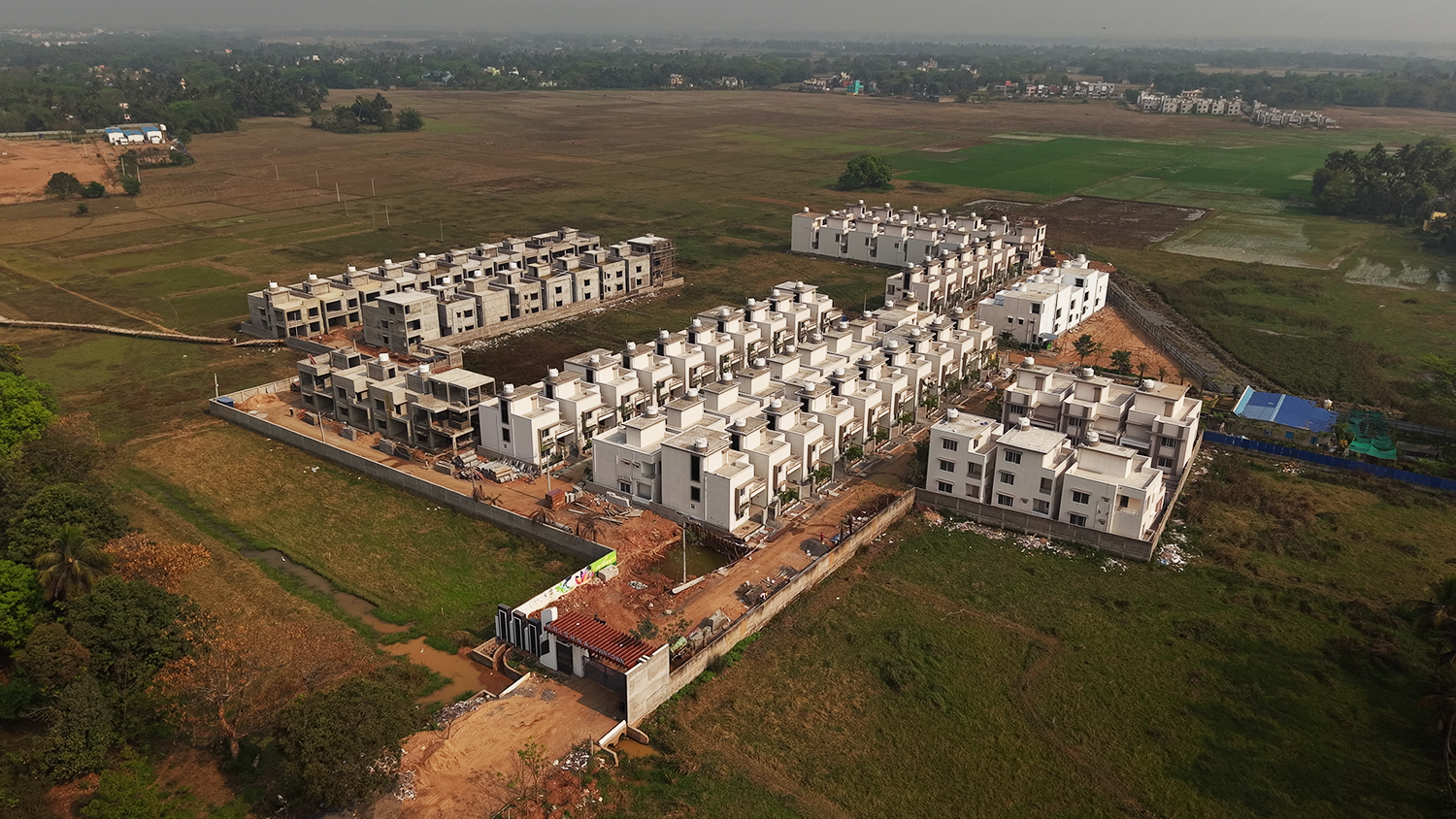

A Beautiful Community Is Easy to Launch. Who Maintains It Five Years Later?
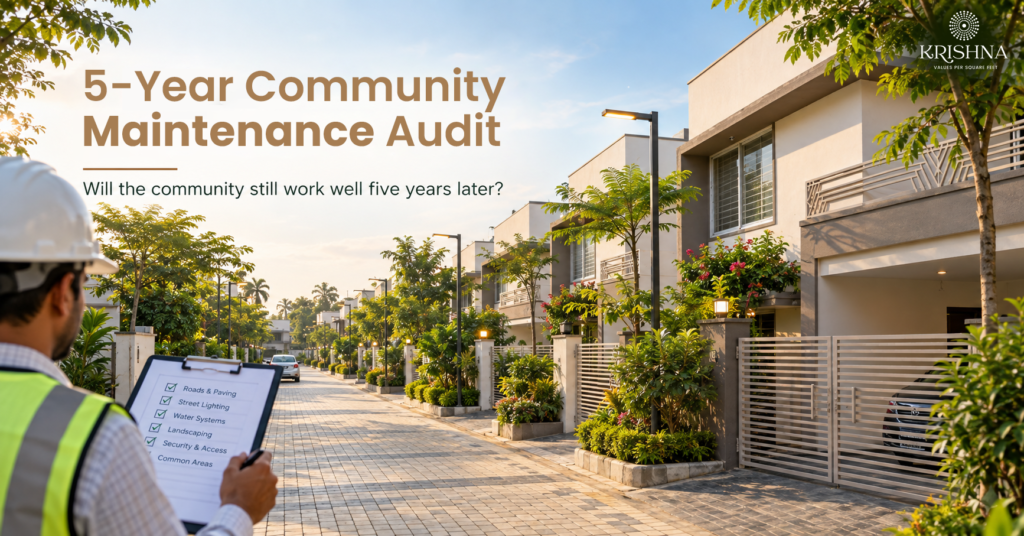
Table of Contents
- Introduction
- Quick Answer: The Eight Questions to Ask Before You Fall for the Amenities
- 1. Who Owns the Maintenance Problem?
- 2. Preventive Maintenance vs “Call Someone When It Breaks”
- 3. Roads, Drains and Streetlights: The Quiet Assets That Age First
- 4. Water Systems Need Records, Not Just a “24×7” Claim
- 5. Security Is an Operating System, Not a Guard at the Gate
- 6. Amenities: Can the Community Maintain What It Markets?
- 7. Landscaping: Who Pays for the Green Look in Year Five?
- 8. Complaint Closure: The Most Revealing Maintenance Metric
- 9. Builder-to-Association Handover: What Should Actually Move Across?
- 10. The Reserve Question: What Happens When a Major Asset Needs Replacement?
- 11. The 5-Year Community Health Audit
- 12. How to Use This Audit in Phulnakhara and Around Bhubaneswar
- Conclusion: Buy the Operating System, Not Just the Opening Day
- FAQ
Introduction
Quick Answer: The Eight Questions to Ask Before You Fall for the Amenities
Before buying in a gated community, ask:
- Who is responsible for each shared asset today—and who takes over later?
- Is there a written preventive-maintenance schedule or only breakdown repair?
- What exactly is included in monthly maintenance, and what is separate?
- Who holds the asset register, manuals, warranties and vendor contracts?
- How are complaints logged, assigned, escalated and closed?
- How will major future repairs or replacements be funded?
- What evidence will residents receive during maintenance handover?
- Can the buyer inspect the systems behind the landscaping—not just the landscaping itself?
Those questions reveal more about long-term community maintenance than a long amenities list.
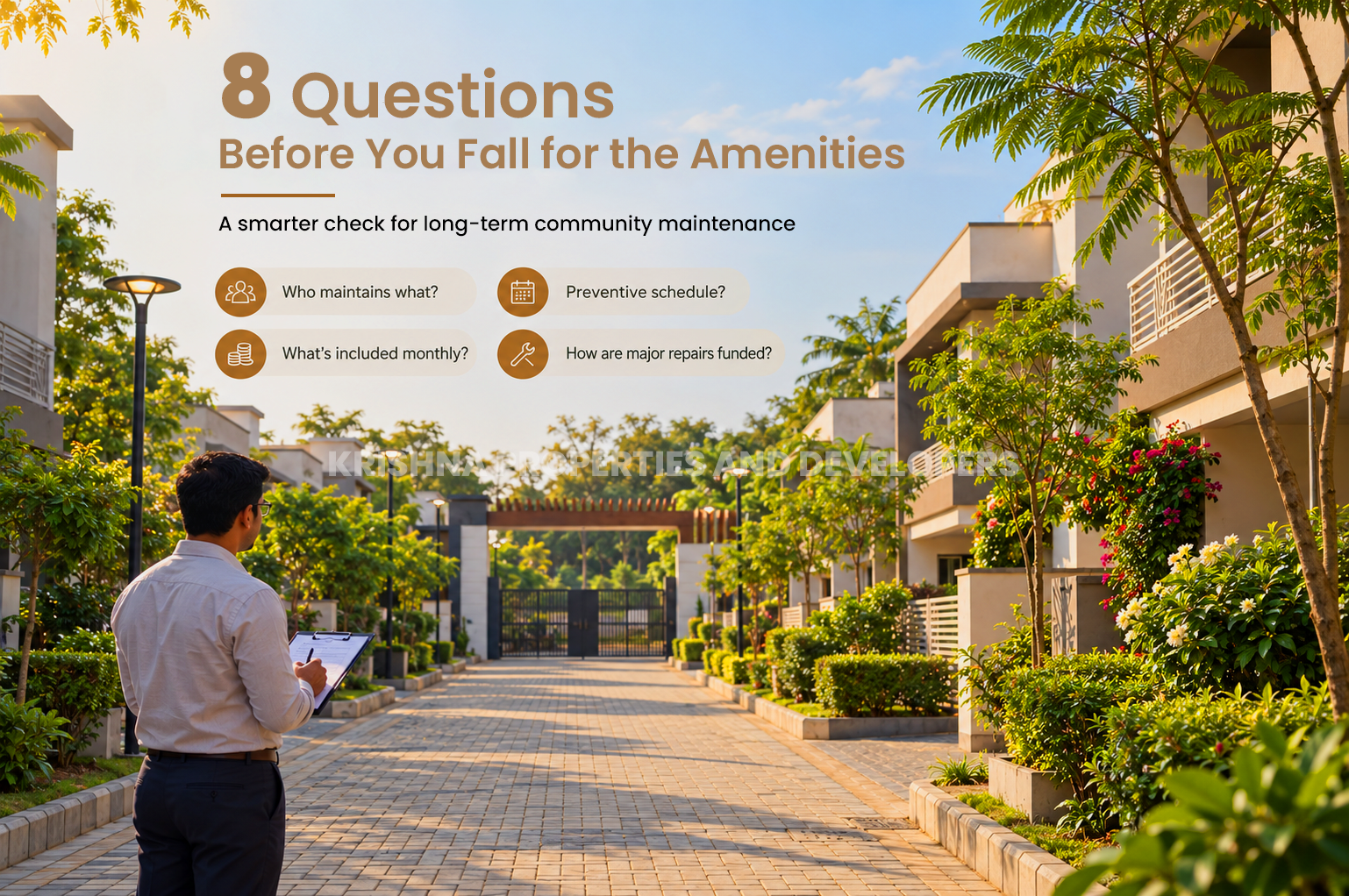
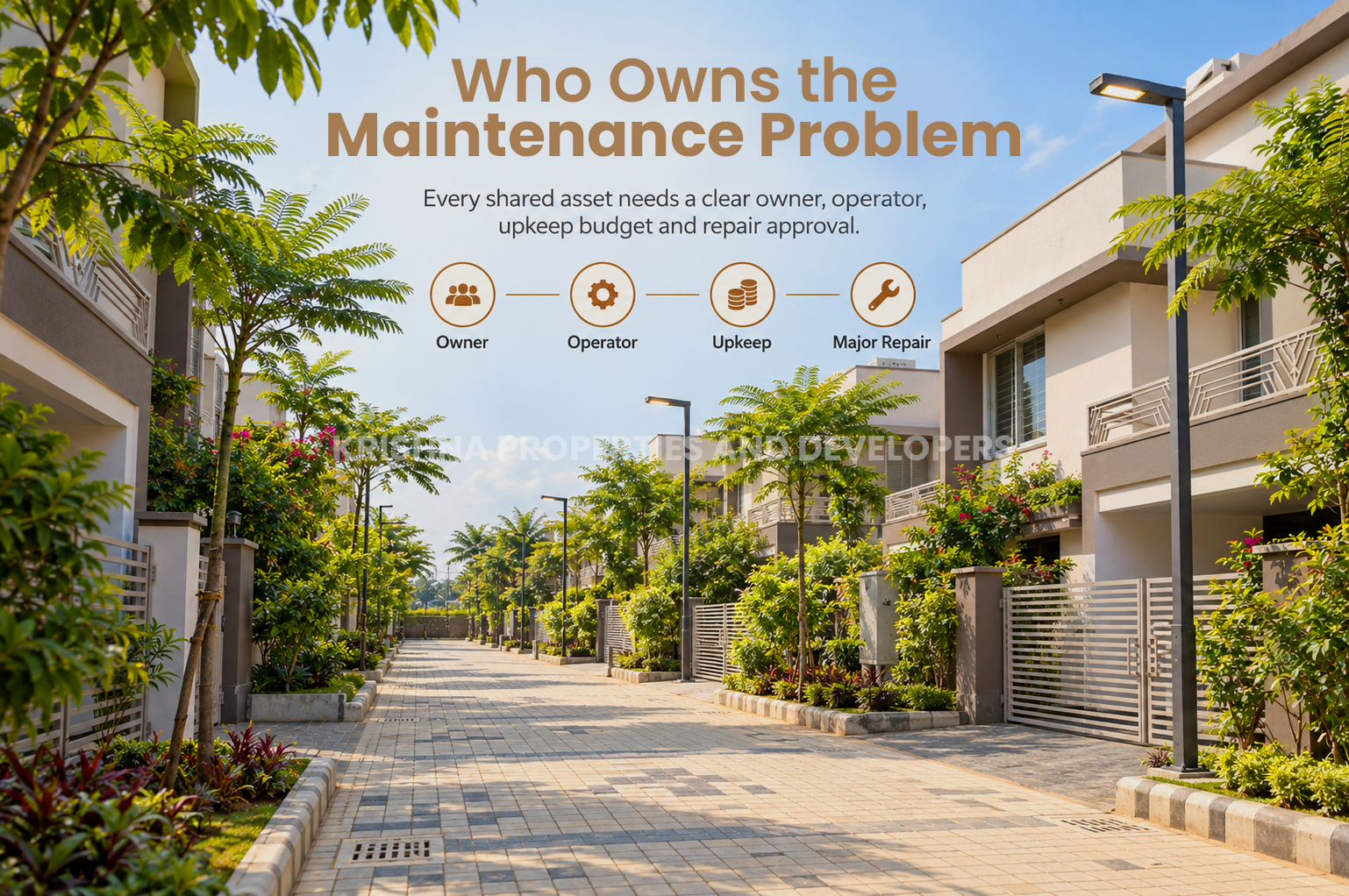
1. Who Owns the Maintenance Problem?
Every shared feature should have an answer to four questions:
- Who owns or controls the asset?
- Who operates it every day?
- Who pays for normal upkeep?
- Who approves major repair or replacement?
Take a streetlight. It may look like one simple amenity, but someone must maintain the wiring, replace fittings, respond to faults and pay the common electricity bill. The same logic applies to gates, pumps, drains, gardens, clubhouses, pools and security equipment.
Under the central RERA framework, a promoter is responsible for providing and maintaining essential services on reasonable charges until the association of allottees takes over maintenance, and the promoter must enable formation of the association as applicable. RERA also deals with handover of common areas and necessary documents/plans to the association or competent authority. The exact project process should still be checked against the agreement, project type, Odisha rules and current ORERA records.
2. Preventive Maintenance vs “Call Someone When It Breaks”
The biggest difference between a community that ages well and one that becomes expensive to run is often invisible during a site visit: preventive maintenance.
A reactive system waits for a pump, light, gate motor or drain to fail. A preventive system knows what needs inspection before failure, how often it should be checked, who is responsible and what record proves that the task was completed.
CPWD’s maintenance guidance describes preventive maintenance as planned work intended to keep services and assets serviceable and to replace components before wear leads to failure. Its guidance also stresses periodic inspection of drains, water systems, electrical systems and other building services. A private residential community will use its own maintenance plan, but the operating principle is useful for buyers: maintenance should have a calendar, not just a phone number.
| Buyer Question | Weak Answer | Stronger Evidence |
| How are pumps maintained? | “We have a maintenance team.” | Pump list + service frequency + vendor/technician responsibility |
| How are drains handled before monsoon? | “Housekeeping cleans them.” | Pre-monsoon inspection/cleaning schedule + issue log |
| How are gate systems maintained? | “Security manages it.” | AMC/service record + manual override procedure |
| How are common lights checked? | “We replace them when they fail.” | Inspection route + fault log + replacement responsibility |
3. Roads, Drains and Streetlights: The Quiet Assets That Age First
Buyers often spend more time photographing the clubhouse than inspecting the assets they will use every single day.
For common area maintenance, start with the unglamorous systems:
- internal-road surface and edge condition
- storm-water drains and covers
- streetlights and cabling
- road markings / signage where provided
- visitor and overflow parking management
- gate hardware and barriers
- common boundary or fencing elements
Ask what happens after three or four monsoons. Is there a planned inspection after heavy rain? Who reports settlement, broken drain covers or failed lights? Does the community keep a work-order history, or does every problem restart as a fresh WhatsApp discussion?
4. Water Systems Need Records, Not Just a “24×7” Claim
A reliable community water system is an operations problem as much as a source problem.
A buyer should connect the maintenance conversation to the entire water chain: source, storage, pumping, distribution, tank cleaning, water-quality testing where applicable and backup arrangements.
The useful maintenance questions are:
- Who inspects pumps and control panels?
- How are tank-cleaning dates recorded?
- Who responds to a distribution leak?
- Is there a log of recurring low-pressure complaints?
- Who pays for major pump replacement?
- What happens to essential pumping during a power interruption?
This is where the earlier residential water-system audit and this article connect: one explains how the system works; this article asks whether the system has a maintenance owner five years later.
5. Security Is an Operating System, Not a Guard at the Gate
A security cabin can look impressive on day one. The real operating questions arrive later.
- Who manages guard rostering and replacements?
- Who maintains CCTV cameras, recording equipment and gate hardware?
- How are visitor logs or digital systems backed up?
- Who tests emergency gate access?
- How are incidents documented and escalated?
- Who reviews dark spots when landscaping grows?
Good residential facility management does not depend on one individual guard remembering everything. It creates repeatable processes, records and escalation routes.
6. Amenities: Can the Community Maintain What It Markets?
The more amenities a project advertises, the more assets someone must inspect, clean, service, repair and eventually replace.
A swimming pool is not only a photograph. It involves water quality, circulation equipment, surfaces, lighting, cleaning and operating rules. A gym means equipment servicing, electrical safety and replacement planning. A clubhouse brings cleaning, plumbing, lighting, furniture and booking management. A children’s play area needs surface and equipment inspections.
So instead of asking:
“How many amenities are there?”
ask:
“Which amenities have the highest operating burden, and what is the maintenance plan for each?”
This is a different question from whether amenities add lifestyle value. It tests whether the promised lifestyle is operationally sustainable.
7. Landscaping: Who Pays for the Green Look in Year Five?
Greenery is one of the easiest features to admire and one of the easiest to underestimate as an operating responsibility.
Landscape maintenance can involve irrigation, pruning, replacement planting, lawn care, pest control, leaf/waste management, lighting and protection of roots from damaging paving or drains.
A buyer does not need a horticulture degree. Ask three simple questions:
1. What is permanent landscape infrastructure and what is temporary launch landscaping?
2. Who maintains common green areas after handover?
3. How is recurring landscape cost included in the operating budget?
The goal is not to choose less greenery. It is to understand how the greenery is expected to stay healthy.
8. Complaint Closure: The Most Revealing Maintenance Metric
One of the best ways to understand a community’s maintenance culture is to ask how a resident complaint moves from “reported” to “closed.”
A useful process has at least five stages:
1. Reported
2. Acknowledged
3. Assigned
4. Actioned
5. Rechecked / Closed
Ask whether recurring issues are tracked by category. If the same streetlight, drain or pump fails repeatedly, a good system should reveal that pattern instead of treating each complaint as unrelated.
This is why a digital app is not automatically proof of good RWA maintenance or facility management. The more important question is whether tickets actually close with evidence and whether repeated faults trigger a root-cause review.
9. Builder-to-Association Handover: What Should Actually Move Across?
The most important maintenance transition is not the day a new facility manager arrives. It is the point at which knowledge about the community moves from the promoter/project team to the entity that will operate the shared assets long term.
A buyer should ask whether the handover package will include, as applicable:
• approved/current plans and common-area documents
• asset register
• equipment manuals
• warranties and guarantee records
• AMC/vendor agreements
• service history
• key contacts and escalation matrix
• utility account / meter information where relevant
• pending-defect or work-order list
• maintenance budget and outstanding commitments
• spares / keys / access credentials where applicable
RERA’s central framework requires promoters to enable formation of the association and addresses transfer of common areas and necessary documents/plans. For an individual project, the actual legal structure, timing and handover documents should be checked against the agreement, applicable state law and ORERA information rather than assumed from a generic checklist.
10. The Reserve Question: What Happens When a Major Asset Needs Replacement?
The final step is not a government form. It is information management.
Create one permanent property document file with the same folder structure in physical and digital form.
Folder | What to Store |
01 · Registration | Registered deed, registration reference, fee/stamp records, certified copies |
02 · Revenue | Mutation reference/order, RoR Odisha, Bhulekh extracts/maps |
03 · Tax / Local Body | Holding/property assessment, ownership update, tax receipts |
04 · Utilities | Electricity name-transfer record, water/other service records where applicable |
05 · Loan / Income Tax | Loan papers, document inventory, current TDS/challan/statement records where applicable |
06 · Project / Handover | Possession letter, handover sheet, warranties, approvals/documents supplied to buyer |
07 · Maintenance | Maintenance receipts, association/RWA documents, service records |
08 · Evidence | Property photographs at handover, meter readings, key correspondence |
11. The 5-Year Community Health Audit
| System | Ask This | Evidence Worth Seeing |
| Roads & drainage | What is inspected before/after monsoon? | Inspection/cleaning schedule, work-order history |
| Water | Who maintains pumps, tanks and distribution? | Asset list, service records, cleaning/testing schedule |
| Street lighting | How are faults identified and closed? | Inspection route, fault log, vendor/electrician responsibility |
| Security | Who maintains people + equipment? | Roster/process, CCTV/gate AMC, escalation procedure |
| Landscaping | Who maintains irrigation and replacement planting? | Scope of work, landscape vendor/plan |
| Amenities | What is the service calendar for each amenity? | Asset-wise AMC/maintenance schedule |
| Complaints | How is repeat failure tracked? | Ticket/work-order history, closure process |
| Major repairs | How are future replacements funded? | Reserve/budget policy, approved governance documents |
A Three-Level Evidence Test
| Level | What You Receive | Buyer Interpretation |
| Level 0 – Promise | “It will be maintained.” | Too vague to compare. |
| Level 1 – Process | A named responsible party and explained workflow. | Useful, but ask what records support it. |
| Level 2 – Evidence | Schedules, asset lists, contracts, logs, budgets or handover documents where appropriate. | Stronger basis for comparison; still verify current applicability. |
12. How to Use This Audit in Phulnakhara and Around Bhubaneswar
For buyers comparing a gated community near Bhubaneswar or a villa in Phulnakhara, long-term maintenance should be evaluated separately from location, home layout and launch-day amenities.
The current Krishna Downtown project website lists shared/lifestyle features including a swimming pool, gym, garden space, indoor games, walking track, banquet hall, children’s play area, multipurpose court, clubhouse, gazebo, lawn and other amenities. Those features create a useful buyer question: what is the current operating and maintenance plan for each shared asset?
If Krishna Downtown is part of your shortlist, ask the Krishna Properties and Developer team for the latest project-specific information on:
- who manages common areas at the current project stage
- what the maintenance scope includes
- how amenity operating responsibilities are planned
- how future association / maintenance handover is structured
- what documents and records will support that transition
- which maintenance charges or reserves apply to the exact phase/unit, if already determined
Do not infer a maintenance promise from an amenity photograph. Ask for the current written/project-specific answer.
Conclusion: Buy the Operating System, Not Just the Opening Day
A beautiful community can be created for launch.
A well-maintained community has to be recreated every day.
Someone must inspect the drains before the monsoon. Someone must notice the failing streetlight. Someone must maintain the pump before it stops. Someone must close the complaint, renew the contract, replace the worn equipment and explain where the money went.
That is the real meaning of gated community maintenance.
So when you visit a project, enjoy the landscaping. Walk through the clubhouse. Look at the roads and the garden.
Then ask the question that belongs to Year Five:
Who will still be responsible for this when “new” is no longer doing the work?
FAQs
What should buyers check about gated community maintenance before buying?
Check who maintains each shared asset, whether preventive schedules exist, how complaints are closed, how maintenance responsibility changes after handover, what records support the process and how major repairs will be funded.
Who maintains common areas before the residents’ association takes over?
Under the central RERA framework, the promoter has responsibilities for providing and maintaining essential services on reasonable charges until the association of allottees takes over maintenance, subject to the agreement and applicable law.
Is a low maintenance charge always better?
No. A lower charge can reflect efficiency, fewer services or a different scope—but it can also mean repairs or future reserves are underfunded. Buyers should compare the scope and budget, not only the headline number.
What is preventive maintenance in a residential community?
It means planned inspection and servicing intended to keep assets working and address wear before breakdown. Examples include scheduled pump servicing, drain cleaning, electrical checks and gate-equipment maintenance.
What should be handed over from the builder to the association or maintenance entity?
Depending on the project and applicable law, buyers should ask about common-area plans/documents, asset lists, warranties, manuals, service records, vendor contracts, keys/credentials, budgets and pending work records.
How can buyers judge whether amenities will still work after five years?
Ask for the maintenance responsibility, service frequency, expected major replacements and funding approach for each high-maintenance amenity—not just whether the amenity exists.
What is the difference between monthly maintenance and a major repair reserve?
Monthly maintenance usually supports routine operations and recurring services. A major repair/replacement reserve, where applicable, is intended for larger future capital needs. The exact structure depends on project documents, association rules and applicable law.
What should Krishna Downtown buyers ask about maintenance?
Ask Krishna Properties and Developer for the latest phase-specific maintenance scope, current common-area operating responsibility, amenity maintenance plan, applicable charges/reserves if determined, and the planned handover process. Do not assume these from a general blog or amenity list.

Krishna Developers
Planning to buy a villa near Bhubaneswar?
- Explore Krishna Downtown, Phulnakhara, a premium gated villa community designed for families who value space, peace, greenery, and connectivity.
- Connect with the Krishna Developers team to understand project details, location advantages, RERA information, and site visit options.
Share
A Beautiful Community Is Easy to Launch. Who Maintains It Five Years Later?
Table of Contents
- Introduction
- What Should You Do After Property Registration in Odisha?
- Step 1: Secure the Final Registered Sale Deed and Registration Trail
- Step 2: Confirm That the Mutation Case Has Actually Been Initiated
- Step 3: Verify the Updated RoR on Bhulekh Odisha
- Step 4: Run a Three-Record Identity Check
- Step 5: Decide Whether You Need a Fresh Encumbrance / Transaction Record
- Step 6: Update the Correct Local Property-Tax Record
- Step 7: Move Electricity and Other Utility Records Into the Right Name
- Step 8: Close the Tax and Home-Loan Paper Trail
- Step 9: Build a Property Vault Before the Documents Scatter
- FAQ
Introduction
The signatures are complete. The biometrics are done. The registered sale deed is finally in your name.
For many buyers, this is the moment when the property file is closed, placed in a cupboard and forgotten.
But from an ownership-management point of view, property registration in Odisha is better treated as the start of a short follow-up sequence—not the final administrative step.
The reason is simple: different systems record different parts of your ownership journey. The registration office preserves the registered transaction. The revenue system deals with mutation and RoR. A municipality or other local body may maintain a property-tax or holding record. The electricity distributor maintains the consumer account. Your lender may hold original documents. Your income-tax paperwork may have its own closing steps.
The useful question after registration is therefore not:
“Do I own the property now?”
It is:
“Have all the records that will matter later been updated, checked and safely stored?”
Quick Answer: The Eight Questions to Ask Before You Fall for the Amenities
Before buying in a gated community, ask:
- Who is responsible for each shared asset today—and who takes over later?
- Is there a written preventive-maintenance schedule or only breakdown repair?
- What exactly is included in monthly maintenance, and what is separate?
- Who holds the asset register, manuals, warranties and vendor contracts?
- How are complaints logged, assigned, escalated and closed?
- How will major future repairs or replacements be funded?
- What evidence will residents receive during maintenance handover?
- Can the buyer inspect the systems behind the landscaping—not just the landscaping itself?
Those questions reveal more about long-term community maintenance than a long amenities list.
1. Who Owns the Maintenance Problem?
Every shared feature should have an answer to four questions:
- Who owns or controls the asset?
- Who operates it every day?
- Who pays for normal upkeep?
- Who approves major repair or replacement?
Take a streetlight. It may look like one simple amenity, but someone must maintain the wiring, replace fittings, respond to faults and pay the common electricity bill. The same logic applies to gates, pumps, drains, gardens, clubhouses, pools and security equipment.
Under the central RERA framework, a promoter is responsible for providing and maintaining essential services on reasonable charges until the association of allottees takes over maintenance, and the promoter must enable formation of the association as applicable. RERA also deals with handover of common areas and necessary documents/plans to the association or competent authority. The exact project process should still be checked against the agreement, project type, Odisha rules and current ORERA records.
2. Preventive Maintenance vs “Call Someone When It Breaks”
The biggest difference between a community that ages well and one that becomes expensive to run is often invisible during a site visit: preventive maintenance.
A reactive system waits for a pump, light, gate motor or drain to fail. A preventive system knows what needs inspection before failure, how often it should be checked, who is responsible and what record proves that the task was completed.
CPWD’s maintenance guidance describes preventive maintenance as planned work intended to keep services and assets serviceable and to replace components before wear leads to failure. Its guidance also stresses periodic inspection of drains, water systems, electrical systems and other building services. A private residential community will use its own maintenance plan, but the operating principle is useful for buyers: maintenance should have a calendar, not just a phone number.
| Buyer Question | Weak Answer | Stronger Evidence |
| How are pumps maintained? | “We have a maintenance team.” | Pump list + service frequency + vendor/technician responsibility |
| How are drains handled before monsoon? | “Housekeeping cleans them.” | Pre-monsoon inspection/cleaning schedule + issue log |
| How are gate systems maintained? | “Security manages it.” | AMC/service record + manual override procedure |
| How are common lights checked? | “We replace them when they fail.” | Inspection route + fault log + replacement responsibility |
3. Roads, Drains and Streetlights: The Quiet Assets That Age First
Buyers often spend more time photographing the clubhouse than inspecting the assets they will use every single day.
For common area maintenance, start with the unglamorous systems:
- internal-road surface and edge condition
- storm-water drains and covers
- streetlights and cabling
- road markings / signage where provided
- visitor and overflow parking management
- gate hardware and barriers
- common boundary or fencing elements
Ask what happens after three or four monsoons. Is there a planned inspection after heavy rain? Who reports settlement, broken drain covers or failed lights? Does the community keep a work-order history, or does every problem restart as a fresh WhatsApp discussion?
4. Water Systems Need Records, Not Just a “24×7” Claim
A reliable community water system is an operations problem as much as a source problem.
A buyer should connect the maintenance conversation to the entire water chain: source, storage, pumping, distribution, tank cleaning, water-quality testing where applicable and backup arrangements.
The useful maintenance questions are:
- Who inspects pumps and control panels?
- How are tank-cleaning dates recorded?
- Who responds to a distribution leak?
- Is there a log of recurring low-pressure complaints?
- Who pays for major pump replacement?
- What happens to essential pumping during a power interruption?
This is where the earlier residential water-system audit and this article connect: one explains how the system works; this article asks whether the system has a maintenance owner five years later.
5. Security Is an Operating System, Not a Guard at the Gate
A security cabin can look impressive on day one. The real operating questions arrive later.
- Who manages guard rostering and replacements?
- Who maintains CCTV cameras, recording equipment and gate hardware?
- How are visitor logs or digital systems backed up?
- Who tests emergency gate access?
- How are incidents documented and escalated?
- Who reviews dark spots when landscaping grows?
Good residential facility management does not depend on one individual guard remembering everything. It creates repeatable processes, records and escalation routes.
6. Amenities: Can the Community Maintain What It Markets?
The more amenities a project advertises, the more assets someone must inspect, clean, service, repair and eventually replace.
A swimming pool is not only a photograph. It involves water quality, circulation equipment, surfaces, lighting, cleaning and operating rules. A gym means equipment servicing, electrical safety and replacement planning. A clubhouse brings cleaning, plumbing, lighting, furniture and booking management. A children’s play area needs surface and equipment inspections.
So instead of asking:
“How many amenities are there?”
ask:
“Which amenities have the highest operating burden, and what is the maintenance plan for each?”
This is a different question from whether amenities add lifestyle value. It tests whether the promised lifestyle is operationally sustainable.
7. Landscaping: Who Pays for the Green Look in Year Five?
Greenery is one of the easiest features to admire and one of the easiest to underestimate as an operating responsibility.
Landscape maintenance can involve irrigation, pruning, replacement planting, lawn care, pest control, leaf/waste management, lighting and protection of roots from damaging paving or drains.
A buyer does not need a horticulture degree. Ask three simple questions:
1. What is permanent landscape infrastructure and what is temporary launch landscaping?
2. Who maintains common green areas after handover?
3. How is recurring landscape cost included in the operating budget?
The goal is not to choose less greenery. It is to understand how the greenery is expected to stay healthy.
8. Complaint Closure: The Most Revealing Maintenance Metric
One of the best ways to understand a community’s maintenance culture is to ask how a resident complaint moves from “reported” to “closed.”
A useful process has at least five stages:
1. Reported
2. Acknowledged
3. Assigned
4. Actioned
5. Rechecked / Closed
Ask whether recurring issues are tracked by category. If the same streetlight, drain or pump fails repeatedly, a good system should reveal that pattern instead of treating each complaint as unrelated.
This is why a digital app is not automatically proof of good RWA maintenance or facility management. The more important question is whether tickets actually close with evidence and whether repeated faults trigger a root-cause review.
9. Builder-to-Association Handover: What Should Actually Move Across?
The most important maintenance transition is not the day a new facility manager arrives. It is the point at which knowledge about the community moves from the promoter/project team to the entity that will operate the shared assets long term.
A buyer should ask whether the handover package will include, as applicable:
• approved/current plans and common-area documents
• asset register
• equipment manuals
• warranties and guarantee records
• AMC/vendor agreements
• service history
• key contacts and escalation matrix
• utility account / meter information where relevant
• pending-defect or work-order list
• maintenance budget and outstanding commitments
• spares / keys / access credentials where applicable
RERA’s central framework requires promoters to enable formation of the association and addresses transfer of common areas and necessary documents/plans. For an individual project, the actual legal structure, timing and handover documents should be checked against the agreement, applicable state law and ORERA information rather than assumed from a generic checklist.
10. The Reserve Question: What Happens When a Major Asset Needs Replacement?
The final step is not a government form. It is information management.
Create one permanent property document file with the same folder structure in physical and digital form.
Folder | What to Store |
01 · Registration | Registered deed, registration reference, fee/stamp records, certified copies |
02 · Revenue | Mutation reference/order, RoR Odisha, Bhulekh extracts/maps |
03 · Tax / Local Body | Holding/property assessment, ownership update, tax receipts |
04 · Utilities | Electricity name-transfer record, water/other service records where applicable |
05 · Loan / Income Tax | Loan papers, document inventory, current TDS/challan/statement records where applicable |
06 · Project / Handover | Possession letter, handover sheet, warranties, approvals/documents supplied to buyer |
07 · Maintenance | Maintenance receipts, association/RWA documents, service records |
08 · Evidence | Property photographs at handover, meter readings, key correspondence |
FAQs
What should buyers check about gated community maintenance before buying?
Check who maintains each shared asset, whether preventive schedules exist, how complaints are closed, how maintenance responsibility changes after handover, what records support the process and how major repairs will be funded.
Who maintains common areas before the residents’ association takes over?
Under the central RERA framework, the promoter has responsibilities for providing and maintaining essential services on reasonable charges until the association of allottees takes over maintenance, subject to the agreement and applicable law.
Is a low maintenance charge always better?
No. A lower charge can reflect efficiency, fewer services or a different scope—but it can also mean repairs or future reserves are underfunded. Buyers should compare the scope and budget, not only the headline number.
What is preventive maintenance in a residential community?
It means planned inspection and servicing intended to keep assets working and address wear before breakdown. Examples include scheduled pump servicing, drain cleaning, electrical checks and gate-equipment maintenance.
What should be handed over from the builder to the association or maintenance entity?
Depending on the project and applicable law, buyers should ask about common-area plans/documents, asset lists, warranties, manuals, service records, vendor contracts, keys/credentials, budgets and pending work records.
How can buyers judge whether amenities will still work after five years?
Ask for the maintenance responsibility, service frequency, expected major replacements and funding approach for each high-maintenance amenity—not just whether the amenity exists.
What is the difference between monthly maintenance and a major repair reserve?
Monthly maintenance usually supports routine operations and recurring services. A major repair/replacement reserve, where applicable, is intended for larger future capital needs. The exact structure depends on project documents, association rules and applicable law.
What should Krishna Downtown buyers ask about maintenance?
Ask Krishna Properties and Developer for the latest phase-specific maintenance scope, current common-area operating responsibility, amenity maintenance plan, applicable charges/reserves if determined, and the planned handover process. Do not assume these from a general blog or amenity list.
Krishna Developers
Planning to buy a villa near Bhubaneswar?
- Explore Krishna Downtown, Phulnakhara, a premium gated villa community designed for families who value space, peace, greenery, and connectivity.
- Connect with the Krishna Developers team to understand project details, location advantages, RERA information, and site visit options.
Share
A Beautiful Community Is Easy to Launch. Who Maintains It Five Years Later?
Table of Contents
- Introduction
- What Should You Do After Property Registration in Odisha?
- Step 1: Secure the Final Registered Sale Deed and Registration Trail
- Step 2: Confirm That the Mutation Case Has Actually Been Initiated
- Step 3: Verify the Updated RoR on Bhulekh Odisha
- Step 4: Run a Three-Record Identity Check
- Step 5: Decide Whether You Need a Fresh Encumbrance / Transaction Record
- Step 6: Update the Correct Local Property-Tax Record
- Step 7: Move Electricity and Other Utility Records Into the Right Name
- Step 8: Close the Tax and Home-Loan Paper Trail
- Step 9: Build a Property Vault Before the Documents Scatter
- FAQ
Introduction
The signatures are complete. The biometrics are done. The registered sale deed is finally in your name.
For many buyers, this is the moment when the property file is closed, placed in a cupboard and forgotten.
But from an ownership-management point of view, property registration in Odisha is better treated as the start of a short follow-up sequence—not the final administrative step.
The reason is simple: different systems record different parts of your ownership journey. The registration office preserves the registered transaction. The revenue system deals with mutation and RoR. A municipality or other local body may maintain a property-tax or holding record. The electricity distributor maintains the consumer account. Your lender may hold original documents. Your income-tax paperwork may have its own closing steps.
The useful question after registration is therefore not:
“Do I own the property now?”
It is:
“Have all the records that will matter later been updated, checked and safely stored?”
Quick Answer: The Eight Questions to Ask Before You Fall for the Amenities
Before buying in a gated community, ask:
- Who is responsible for each shared asset today—and who takes over later?
- Is there a written preventive-maintenance schedule or only breakdown repair?
- What exactly is included in monthly maintenance, and what is separate?
- Who holds the asset register, manuals, warranties and vendor contracts?
- How are complaints logged, assigned, escalated and closed?
- How will major future repairs or replacements be funded?
- What evidence will residents receive during maintenance handover?
- Can the buyer inspect the systems behind the landscaping—not just the landscaping itself?
Those questions reveal more about long-term community maintenance than a long amenities list.
1. Who Owns the Maintenance Problem?
Every shared feature should have an answer to four questions:
- Who owns or controls the asset?
- Who operates it every day?
- Who pays for normal upkeep?
- Who approves major repair or replacement?
Take a streetlight. It may look like one simple amenity, but someone must maintain the wiring, replace fittings, respond to faults and pay the common electricity bill. The same logic applies to gates, pumps, drains, gardens, clubhouses, pools and security equipment.
Under the central RERA framework, a promoter is responsible for providing and maintaining essential services on reasonable charges until the association of allottees takes over maintenance, and the promoter must enable formation of the association as applicable. RERA also deals with handover of common areas and necessary documents/plans to the association or competent authority. The exact project process should still be checked against the agreement, project type, Odisha rules and current ORERA records.
2. Preventive Maintenance vs “Call Someone When It Breaks”
The biggest difference between a community that ages well and one that becomes expensive to run is often invisible during a site visit: preventive maintenance.
A reactive system waits for a pump, light, gate motor or drain to fail. A preventive system knows what needs inspection before failure, how often it should be checked, who is responsible and what record proves that the task was completed.
CPWD’s maintenance guidance describes preventive maintenance as planned work intended to keep services and assets serviceable and to replace components before wear leads to failure. Its guidance also stresses periodic inspection of drains, water systems, electrical systems and other building services. A private residential community will use its own maintenance plan, but the operating principle is useful for buyers: maintenance should have a calendar, not just a phone number.
| Buyer Question | Weak Answer | Stronger Evidence |
| How are pumps maintained? | “We have a maintenance team.” | Pump list + service frequency + vendor/technician responsibility |
| How are drains handled before monsoon? | “Housekeeping cleans them.” | Pre-monsoon inspection/cleaning schedule + issue log |
| How are gate systems maintained? | “Security manages it.” | AMC/service record + manual override procedure |
| How are common lights checked? | “We replace them when they fail.” | Inspection route + fault log + replacement responsibility |
3. Roads, Drains and Streetlights: The Quiet Assets That Age First
Buyers often spend more time photographing the clubhouse than inspecting the assets they will use every single day.
For common area maintenance, start with the unglamorous systems:
- internal-road surface and edge condition
- storm-water drains and covers
- streetlights and cabling
- road markings / signage where provided
- visitor and overflow parking management
- gate hardware and barriers
- common boundary or fencing elements
Ask what happens after three or four monsoons. Is there a planned inspection after heavy rain? Who reports settlement, broken drain covers or failed lights? Does the community keep a work-order history, or does every problem restart as a fresh WhatsApp discussion?
4. Water Systems Need Records, Not Just a “24×7” Claim
A reliable community water system is an operations problem as much as a source problem.
A buyer should connect the maintenance conversation to the entire water chain: source, storage, pumping, distribution, tank cleaning, water-quality testing where applicable and backup arrangements.
The useful maintenance questions are:
- Who inspects pumps and control panels?
- How are tank-cleaning dates recorded?
- Who responds to a distribution leak?
- Is there a log of recurring low-pressure complaints?
- Who pays for major pump replacement?
- What happens to essential pumping during a power interruption?
This is where the earlier residential water-system audit and this article connect: one explains how the system works; this article asks whether the system has a maintenance owner five years later.
5. Security Is an Operating System, Not a Guard at the Gate
A security cabin can look impressive on day one. The real operating questions arrive later.
- Who manages guard rostering and replacements?
- Who maintains CCTV cameras, recording equipment and gate hardware?
- How are visitor logs or digital systems backed up?
- Who tests emergency gate access?
- How are incidents documented and escalated?
- Who reviews dark spots when landscaping grows?
Good residential facility management does not depend on one individual guard remembering everything. It creates repeatable processes, records and escalation routes.
6. Amenities: Can the Community Maintain What It Markets?
The more amenities a project advertises, the more assets someone must inspect, clean, service, repair and eventually replace.
A swimming pool is not only a photograph. It involves water quality, circulation equipment, surfaces, lighting, cleaning and operating rules. A gym means equipment servicing, electrical safety and replacement planning. A clubhouse brings cleaning, plumbing, lighting, furniture and booking management. A children’s play area needs surface and equipment inspections.
So instead of asking:
“How many amenities are there?”
ask:
“Which amenities have the highest operating burden, and what is the maintenance plan for each?”
This is a different question from whether amenities add lifestyle value. It tests whether the promised lifestyle is operationally sustainable.
7. Landscaping: Who Pays for the Green Look in Year Five?
Greenery is one of the easiest features to admire and one of the easiest to underestimate as an operating responsibility.
Landscape maintenance can involve irrigation, pruning, replacement planting, lawn care, pest control, leaf/waste management, lighting and protection of roots from damaging paving or drains.
A buyer does not need a horticulture degree. Ask three simple questions:
1. What is permanent landscape infrastructure and what is temporary launch landscaping?
2. Who maintains common green areas after handover?
3. How is recurring landscape cost included in the operating budget?
The goal is not to choose less greenery. It is to understand how the greenery is expected to stay healthy.
8. Complaint Closure: The Most Revealing Maintenance Metric
One of the best ways to understand a community’s maintenance culture is to ask how a resident complaint moves from “reported” to “closed.”
A useful process has at least five stages:
1. Reported
2. Acknowledged
3. Assigned
4. Actioned
5. Rechecked / Closed
Ask whether recurring issues are tracked by category. If the same streetlight, drain or pump fails repeatedly, a good system should reveal that pattern instead of treating each complaint as unrelated.
This is why a digital app is not automatically proof of good RWA maintenance or facility management. The more important question is whether tickets actually close with evidence and whether repeated faults trigger a root-cause review.
9. Builder-to-Association Handover: What Should Actually Move Across?
The most important maintenance transition is not the day a new facility manager arrives. It is the point at which knowledge about the community moves from the promoter/project team to the entity that will operate the shared assets long term.
A buyer should ask whether the handover package will include, as applicable:
• approved/current plans and common-area documents
• asset register
• equipment manuals
• warranties and guarantee records
• AMC/vendor agreements
• service history
• key contacts and escalation matrix
• utility account / meter information where relevant
• pending-defect or work-order list
• maintenance budget and outstanding commitments
• spares / keys / access credentials where applicable
RERA’s central framework requires promoters to enable formation of the association and addresses transfer of common areas and necessary documents/plans. For an individual project, the actual legal structure, timing and handover documents should be checked against the agreement, applicable state law and ORERA information rather than assumed from a generic checklist.
10. The Reserve Question: What Happens When a Major Asset Needs Replacement?
The final step is not a government form. It is information management.
Create one permanent property document file with the same folder structure in physical and digital form.
Folder | What to Store |
01 · Registration | Registered deed, registration reference, fee/stamp records, certified copies |
02 · Revenue | Mutation reference/order, RoR Odisha, Bhulekh extracts/maps |
03 · Tax / Local Body | Holding/property assessment, ownership update, tax receipts |
04 · Utilities | Electricity name-transfer record, water/other service records where applicable |
05 · Loan / Income Tax | Loan papers, document inventory, current TDS/challan/statement records where applicable |
06 · Project / Handover | Possession letter, handover sheet, warranties, approvals/documents supplied to buyer |
07 · Maintenance | Maintenance receipts, association/RWA documents, service records |
08 · Evidence | Property photographs at handover, meter readings, key correspondence |
FAQs
What should buyers check about gated community maintenance before buying?
Check who maintains each shared asset, whether preventive schedules exist, how complaints are closed, how maintenance responsibility changes after handover, what records support the process and how major repairs will be funded.
Who maintains common areas before the residents’ association takes over?
Under the central RERA framework, the promoter has responsibilities for providing and maintaining essential services on reasonable charges until the association of allottees takes over maintenance, subject to the agreement and applicable law.
Is a low maintenance charge always better?
No. A lower charge can reflect efficiency, fewer services or a different scope—but it can also mean repairs or future reserves are underfunded. Buyers should compare the scope and budget, not only the headline number.
What is preventive maintenance in a residential community?
It means planned inspection and servicing intended to keep assets working and address wear before breakdown. Examples include scheduled pump servicing, drain cleaning, electrical checks and gate-equipment maintenance.
What should be handed over from the builder to the association or maintenance entity?
Depending on the project and applicable law, buyers should ask about common-area plans/documents, asset lists, warranties, manuals, service records, vendor contracts, keys/credentials, budgets and pending work records.
How can buyers judge whether amenities will still work after five years?
Ask for the maintenance responsibility, service frequency, expected major replacements and funding approach for each high-maintenance amenity—not just whether the amenity exists.
What is the difference between monthly maintenance and a major repair reserve?
Monthly maintenance usually supports routine operations and recurring services. A major repair/replacement reserve, where applicable, is intended for larger future capital needs. The exact structure depends on project documents, association rules and applicable law.
What should Krishna Downtown buyers ask about maintenance?
Ask Krishna Properties and Developer for the latest phase-specific maintenance scope, current common-area operating responsibility, amenity maintenance plan, applicable charges/reserves if determined, and the planned handover process. Do not assume these from a general blog or amenity list.
Krishna Developers
Planning to buy a villa near Bhubaneswar?
- Explore Krishna Downtown, Phulnakhara, a premium gated villa community designed for families who value space, peace, greenery, and connectivity.
- Connect with the Krishna Developers team to understand project details, location advantages, RERA information, and site visit options.
Share
A Beautiful Community Is Easy to Launch. Who Maintains It Five Years Later?
Table of Contents
- Introduction
- What Should You Do After Property Registration in Odisha?
- Step 1: Secure the Final Registered Sale Deed and Registration Trail
- Step 2: Confirm That the Mutation Case Has Actually Been Initiated
- Step 3: Verify the Updated RoR on Bhulekh Odisha
- Step 4: Run a Three-Record Identity Check
- Step 5: Decide Whether You Need a Fresh Encumbrance / Transaction Record
- Step 6: Update the Correct Local Property-Tax Record
- Step 7: Move Electricity and Other Utility Records Into the Right Name
- Step 8: Close the Tax and Home-Loan Paper Trail
- Step 9: Build a Property Vault Before the Documents Scatter
- FAQ
Introduction
The signatures are complete. The biometrics are done. The registered sale deed is finally in your name.
For many buyers, this is the moment when the property file is closed, placed in a cupboard and forgotten.
But from an ownership-management point of view, property registration in Odisha is better treated as the start of a short follow-up sequence—not the final administrative step.
The reason is simple: different systems record different parts of your ownership journey. The registration office preserves the registered transaction. The revenue system deals with mutation and RoR. A municipality or other local body may maintain a property-tax or holding record. The electricity distributor maintains the consumer account. Your lender may hold original documents. Your income-tax paperwork may have its own closing steps.
The useful question after registration is therefore not:
“Do I own the property now?”
It is:
“Have all the records that will matter later been updated, checked and safely stored?”
Quick Answer: The Eight Questions to Ask Before You Fall for the Amenities
Before buying in a gated community, ask:
- Who is responsible for each shared asset today—and who takes over later?
- Is there a written preventive-maintenance schedule or only breakdown repair?
- What exactly is included in monthly maintenance, and what is separate?
- Who holds the asset register, manuals, warranties and vendor contracts?
- How are complaints logged, assigned, escalated and closed?
- How will major future repairs or replacements be funded?
- What evidence will residents receive during maintenance handover?
- Can the buyer inspect the systems behind the landscaping—not just the landscaping itself?
Those questions reveal more about long-term community maintenance than a long amenities list.
1. Who Owns the Maintenance Problem?
Every shared feature should have an answer to four questions:
- Who owns or controls the asset?
- Who operates it every day?
- Who pays for normal upkeep?
- Who approves major repair or replacement?
Take a streetlight. It may look like one simple amenity, but someone must maintain the wiring, replace fittings, respond to faults and pay the common electricity bill. The same logic applies to gates, pumps, drains, gardens, clubhouses, pools and security equipment.
Under the central RERA framework, a promoter is responsible for providing and maintaining essential services on reasonable charges until the association of allottees takes over maintenance, and the promoter must enable formation of the association as applicable. RERA also deals with handover of common areas and necessary documents/plans to the association or competent authority. The exact project process should still be checked against the agreement, project type, Odisha rules and current ORERA records.
2. Preventive Maintenance vs “Call Someone When It Breaks”
The biggest difference between a community that ages well and one that becomes expensive to run is often invisible during a site visit: preventive maintenance.
A reactive system waits for a pump, light, gate motor or drain to fail. A preventive system knows what needs inspection before failure, how often it should be checked, who is responsible and what record proves that the task was completed.
CPWD’s maintenance guidance describes preventive maintenance as planned work intended to keep services and assets serviceable and to replace components before wear leads to failure. Its guidance also stresses periodic inspection of drains, water systems, electrical systems and other building services. A private residential community will use its own maintenance plan, but the operating principle is useful for buyers: maintenance should have a calendar, not just a phone number.
| Buyer Question | Weak Answer | Stronger Evidence |
| How are pumps maintained? | “We have a maintenance team.” | Pump list + service frequency + vendor/technician responsibility |
| How are drains handled before monsoon? | “Housekeeping cleans them.” | Pre-monsoon inspection/cleaning schedule + issue log |
| How are gate systems maintained? | “Security manages it.” | AMC/service record + manual override procedure |
| How are common lights checked? | “We replace them when they fail.” | Inspection route + fault log + replacement responsibility |
3. Roads, Drains and Streetlights: The Quiet Assets That Age First
Buyers often spend more time photographing the clubhouse than inspecting the assets they will use every single day.
For common area maintenance, start with the unglamorous systems:
- internal-road surface and edge condition
- storm-water drains and covers
- streetlights and cabling
- road markings / signage where provided
- visitor and overflow parking management
- gate hardware and barriers
- common boundary or fencing elements
Ask what happens after three or four monsoons. Is there a planned inspection after heavy rain? Who reports settlement, broken drain covers or failed lights? Does the community keep a work-order history, or does every problem restart as a fresh WhatsApp discussion?
4. Water Systems Need Records, Not Just a “24×7” Claim
A reliable community water system is an operations problem as much as a source problem.
A buyer should connect the maintenance conversation to the entire water chain: source, storage, pumping, distribution, tank cleaning, water-quality testing where applicable and backup arrangements.
The useful maintenance questions are:
- Who inspects pumps and control panels?
- How are tank-cleaning dates recorded?
- Who responds to a distribution leak?
- Is there a log of recurring low-pressure complaints?
- Who pays for major pump replacement?
- What happens to essential pumping during a power interruption?
This is where the earlier residential water-system audit and this article connect: one explains how the system works; this article asks whether the system has a maintenance owner five years later.
5. Security Is an Operating System, Not a Guard at the Gate
A security cabin can look impressive on day one. The real operating questions arrive later.
- Who manages guard rostering and replacements?
- Who maintains CCTV cameras, recording equipment and gate hardware?
- How are visitor logs or digital systems backed up?
- Who tests emergency gate access?
- How are incidents documented and escalated?
- Who reviews dark spots when landscaping grows?
Good residential facility management does not depend on one individual guard remembering everything. It creates repeatable processes, records and escalation routes.
6. Amenities: Can the Community Maintain What It Markets?
The more amenities a project advertises, the more assets someone must inspect, clean, service, repair and eventually replace.
A swimming pool is not only a photograph. It involves water quality, circulation equipment, surfaces, lighting, cleaning and operating rules. A gym means equipment servicing, electrical safety and replacement planning. A clubhouse brings cleaning, plumbing, lighting, furniture and booking management. A children’s play area needs surface and equipment inspections.
So instead of asking:
“How many amenities are there?”
ask:
“Which amenities have the highest operating burden, and what is the maintenance plan for each?”
This is a different question from whether amenities add lifestyle value. It tests whether the promised lifestyle is operationally sustainable.
7. Landscaping: Who Pays for the Green Look in Year Five?
Greenery is one of the easiest features to admire and one of the easiest to underestimate as an operating responsibility.
Landscape maintenance can involve irrigation, pruning, replacement planting, lawn care, pest control, leaf/waste management, lighting and protection of roots from damaging paving or drains.
A buyer does not need a horticulture degree. Ask three simple questions:
1. What is permanent landscape infrastructure and what is temporary launch landscaping?
2. Who maintains common green areas after handover?
3. How is recurring landscape cost included in the operating budget?
The goal is not to choose less greenery. It is to understand how the greenery is expected to stay healthy.
8. Complaint Closure: The Most Revealing Maintenance Metric
One of the best ways to understand a community’s maintenance culture is to ask how a resident complaint moves from “reported” to “closed.”
A useful process has at least five stages:
1. Reported
2. Acknowledged
3. Assigned
4. Actioned
5. Rechecked / Closed
Ask whether recurring issues are tracked by category. If the same streetlight, drain or pump fails repeatedly, a good system should reveal that pattern instead of treating each complaint as unrelated.
This is why a digital app is not automatically proof of good RWA maintenance or facility management. The more important question is whether tickets actually close with evidence and whether repeated faults trigger a root-cause review.
9. Builder-to-Association Handover: What Should Actually Move Across?
The most important maintenance transition is not the day a new facility manager arrives. It is the point at which knowledge about the community moves from the promoter/project team to the entity that will operate the shared assets long term.
A buyer should ask whether the handover package will include, as applicable:
• approved/current plans and common-area documents
• asset register
• equipment manuals
• warranties and guarantee records
• AMC/vendor agreements
• service history
• key contacts and escalation matrix
• utility account / meter information where relevant
• pending-defect or work-order list
• maintenance budget and outstanding commitments
• spares / keys / access credentials where applicable
RERA’s central framework requires promoters to enable formation of the association and addresses transfer of common areas and necessary documents/plans. For an individual project, the actual legal structure, timing and handover documents should be checked against the agreement, applicable state law and ORERA information rather than assumed from a generic checklist.
10. The Reserve Question: What Happens When a Major Asset Needs Replacement?
The final step is not a government form. It is information management.
Create one permanent property document file with the same folder structure in physical and digital form.
Folder | What to Store |
01 · Registration | Registered deed, registration reference, fee/stamp records, certified copies |
02 · Revenue | Mutation reference/order, RoR Odisha, Bhulekh extracts/maps |
03 · Tax / Local Body | Holding/property assessment, ownership update, tax receipts |
04 · Utilities | Electricity name-transfer record, water/other service records where applicable |
05 · Loan / Income Tax | Loan papers, document inventory, current TDS/challan/statement records where applicable |
06 · Project / Handover | Possession letter, handover sheet, warranties, approvals/documents supplied to buyer |
07 · Maintenance | Maintenance receipts, association/RWA documents, service records |
08 · Evidence | Property photographs at handover, meter readings, key correspondence |
FAQs
What should buyers check about gated community maintenance before buying?
Check who maintains each shared asset, whether preventive schedules exist, how complaints are closed, how maintenance responsibility changes after handover, what records support the process and how major repairs will be funded.
Who maintains common areas before the residents’ association takes over?
Under the central RERA framework, the promoter has responsibilities for providing and maintaining essential services on reasonable charges until the association of allottees takes over maintenance, subject to the agreement and applicable law.
Is a low maintenance charge always better?
No. A lower charge can reflect efficiency, fewer services or a different scope—but it can also mean repairs or future reserves are underfunded. Buyers should compare the scope and budget, not only the headline number.
What is preventive maintenance in a residential community?
It means planned inspection and servicing intended to keep assets working and address wear before breakdown. Examples include scheduled pump servicing, drain cleaning, electrical checks and gate-equipment maintenance.
What should be handed over from the builder to the association or maintenance entity?
Depending on the project and applicable law, buyers should ask about common-area plans/documents, asset lists, warranties, manuals, service records, vendor contracts, keys/credentials, budgets and pending work records.
How can buyers judge whether amenities will still work after five years?
Ask for the maintenance responsibility, service frequency, expected major replacements and funding approach for each high-maintenance amenity—not just whether the amenity exists.
What is the difference between monthly maintenance and a major repair reserve?
Monthly maintenance usually supports routine operations and recurring services. A major repair/replacement reserve, where applicable, is intended for larger future capital needs. The exact structure depends on project documents, association rules and applicable law.
What should Krishna Downtown buyers ask about maintenance?
Ask Krishna Properties and Developer for the latest phase-specific maintenance scope, current common-area operating responsibility, amenity maintenance plan, applicable charges/reserves if determined, and the planned handover process. Do not assume these from a general blog or amenity list.
Krishna Developers
Planning to buy a villa near Bhubaneswar?
- Explore Krishna Downtown, Phulnakhara, a premium gated villa community designed for families who value space, peace, greenery, and connectivity.
- Connect with the Krishna Developers team to understand project details, location advantages, RERA information, and site visit options.
Share
A Beautiful Community Is Easy to Launch. Who Maintains It Five Years Later?
Table of Contents
- Introduction
- What Should You Do After Property Registration in Odisha?
- Step 1: Secure the Final Registered Sale Deed and Registration Trail
- Step 2: Confirm That the Mutation Case Has Actually Been Initiated
- Step 3: Verify the Updated RoR on Bhulekh Odisha
- Step 4: Run a Three-Record Identity Check
- Step 5: Decide Whether You Need a Fresh Encumbrance / Transaction Record
- Step 6: Update the Correct Local Property-Tax Record
- Step 7: Move Electricity and Other Utility Records Into the Right Name
- Step 8: Close the Tax and Home-Loan Paper Trail
- Step 9: Build a Property Vault Before the Documents Scatter
- FAQ
Introduction
The signatures are complete. The biometrics are done. The registered sale deed is finally in your name.
For many buyers, this is the moment when the property file is closed, placed in a cupboard and forgotten.
But from an ownership-management point of view, property registration in Odisha is better treated as the start of a short follow-up sequence—not the final administrative step.
The reason is simple: different systems record different parts of your ownership journey. The registration office preserves the registered transaction. The revenue system deals with mutation and RoR. A municipality or other local body may maintain a property-tax or holding record. The electricity distributor maintains the consumer account. Your lender may hold original documents. Your income-tax paperwork may have its own closing steps.
The useful question after registration is therefore not:
“Do I own the property now?”
It is:
“Have all the records that will matter later been updated, checked and safely stored?”
Quick Answer: The Eight Questions to Ask Before You Fall for the Amenities
Before buying in a gated community, ask:
- Who is responsible for each shared asset today—and who takes over later?
- Is there a written preventive-maintenance schedule or only breakdown repair?
- What exactly is included in monthly maintenance, and what is separate?
- Who holds the asset register, manuals, warranties and vendor contracts?
- How are complaints logged, assigned, escalated and closed?
- How will major future repairs or replacements be funded?
- What evidence will residents receive during maintenance handover?
- Can the buyer inspect the systems behind the landscaping—not just the landscaping itself?
Those questions reveal more about long-term community maintenance than a long amenities list.
1. Who Owns the Maintenance Problem?
Every shared feature should have an answer to four questions:
- Who owns or controls the asset?
- Who operates it every day?
- Who pays for normal upkeep?
- Who approves major repair or replacement?
Take a streetlight. It may look like one simple amenity, but someone must maintain the wiring, replace fittings, respond to faults and pay the common electricity bill. The same logic applies to gates, pumps, drains, gardens, clubhouses, pools and security equipment.
Under the central RERA framework, a promoter is responsible for providing and maintaining essential services on reasonable charges until the association of allottees takes over maintenance, and the promoter must enable formation of the association as applicable. RERA also deals with handover of common areas and necessary documents/plans to the association or competent authority. The exact project process should still be checked against the agreement, project type, Odisha rules and current ORERA records.
2. Preventive Maintenance vs “Call Someone When It Breaks”
The biggest difference between a community that ages well and one that becomes expensive to run is often invisible during a site visit: preventive maintenance.
A reactive system waits for a pump, light, gate motor or drain to fail. A preventive system knows what needs inspection before failure, how often it should be checked, who is responsible and what record proves that the task was completed.
CPWD’s maintenance guidance describes preventive maintenance as planned work intended to keep services and assets serviceable and to replace components before wear leads to failure. Its guidance also stresses periodic inspection of drains, water systems, electrical systems and other building services. A private residential community will use its own maintenance plan, but the operating principle is useful for buyers: maintenance should have a calendar, not just a phone number.
| Buyer Question | Weak Answer | Stronger Evidence |
| How are pumps maintained? | “We have a maintenance team.” | Pump list + service frequency + vendor/technician responsibility |
| How are drains handled before monsoon? | “Housekeeping cleans them.” | Pre-monsoon inspection/cleaning schedule + issue log |
| How are gate systems maintained? | “Security manages it.” | AMC/service record + manual override procedure |
| How are common lights checked? | “We replace them when they fail.” | Inspection route + fault log + replacement responsibility |
3. Roads, Drains and Streetlights: The Quiet Assets That Age First
Buyers often spend more time photographing the clubhouse than inspecting the assets they will use every single day.
For common area maintenance, start with the unglamorous systems:
- internal-road surface and edge condition
- storm-water drains and covers
- streetlights and cabling
- road markings / signage where provided
- visitor and overflow parking management
- gate hardware and barriers
- common boundary or fencing elements
Ask what happens after three or four monsoons. Is there a planned inspection after heavy rain? Who reports settlement, broken drain covers or failed lights? Does the community keep a work-order history, or does every problem restart as a fresh WhatsApp discussion?
4. Water Systems Need Records, Not Just a “24×7” Claim
A reliable community water system is an operations problem as much as a source problem.
A buyer should connect the maintenance conversation to the entire water chain: source, storage, pumping, distribution, tank cleaning, water-quality testing where applicable and backup arrangements.
The useful maintenance questions are:
- Who inspects pumps and control panels?
- How are tank-cleaning dates recorded?
- Who responds to a distribution leak?
- Is there a log of recurring low-pressure complaints?
- Who pays for major pump replacement?
- What happens to essential pumping during a power interruption?
This is where the earlier residential water-system audit and this article connect: one explains how the system works; this article asks whether the system has a maintenance owner five years later.
5. Security Is an Operating System, Not a Guard at the Gate
A security cabin can look impressive on day one. The real operating questions arrive later.
- Who manages guard rostering and replacements?
- Who maintains CCTV cameras, recording equipment and gate hardware?
- How are visitor logs or digital systems backed up?
- Who tests emergency gate access?
- How are incidents documented and escalated?
- Who reviews dark spots when landscaping grows?
Good residential facility management does not depend on one individual guard remembering everything. It creates repeatable processes, records and escalation routes.
6. Amenities: Can the Community Maintain What It Markets?
The more amenities a project advertises, the more assets someone must inspect, clean, service, repair and eventually replace.
A swimming pool is not only a photograph. It involves water quality, circulation equipment, surfaces, lighting, cleaning and operating rules. A gym means equipment servicing, electrical safety and replacement planning. A clubhouse brings cleaning, plumbing, lighting, furniture and booking management. A children’s play area needs surface and equipment inspections.
So instead of asking:
“How many amenities are there?”
ask:
“Which amenities have the highest operating burden, and what is the maintenance plan for each?”
This is a different question from whether amenities add lifestyle value. It tests whether the promised lifestyle is operationally sustainable.
7. Landscaping: Who Pays for the Green Look in Year Five?
Greenery is one of the easiest features to admire and one of the easiest to underestimate as an operating responsibility.
Landscape maintenance can involve irrigation, pruning, replacement planting, lawn care, pest control, leaf/waste management, lighting and protection of roots from damaging paving or drains.
A buyer does not need a horticulture degree. Ask three simple questions:
1. What is permanent landscape infrastructure and what is temporary launch landscaping?
2. Who maintains common green areas after handover?
3. How is recurring landscape cost included in the operating budget?
The goal is not to choose less greenery. It is to understand how the greenery is expected to stay healthy.
8. Complaint Closure: The Most Revealing Maintenance Metric
One of the best ways to understand a community’s maintenance culture is to ask how a resident complaint moves from “reported” to “closed.”
A useful process has at least five stages:
1. Reported
2. Acknowledged
3. Assigned
4. Actioned
5. Rechecked / Closed
Ask whether recurring issues are tracked by category. If the same streetlight, drain or pump fails repeatedly, a good system should reveal that pattern instead of treating each complaint as unrelated.
This is why a digital app is not automatically proof of good RWA maintenance or facility management. The more important question is whether tickets actually close with evidence and whether repeated faults trigger a root-cause review.
9. Builder-to-Association Handover: What Should Actually Move Across?
The most important maintenance transition is not the day a new facility manager arrives. It is the point at which knowledge about the community moves from the promoter/project team to the entity that will operate the shared assets long term.
A buyer should ask whether the handover package will include, as applicable:
• approved/current plans and common-area documents
• asset register
• equipment manuals
• warranties and guarantee records
• AMC/vendor agreements
• service history
• key contacts and escalation matrix
• utility account / meter information where relevant
• pending-defect or work-order list
• maintenance budget and outstanding commitments
• spares / keys / access credentials where applicable
RERA’s central framework requires promoters to enable formation of the association and addresses transfer of common areas and necessary documents/plans. For an individual project, the actual legal structure, timing and handover documents should be checked against the agreement, applicable state law and ORERA information rather than assumed from a generic checklist.
10. The Reserve Question: What Happens When a Major Asset Needs Replacement?
The final step is not a government form. It is information management.
Create one permanent property document file with the same folder structure in physical and digital form.
Folder | What to Store |
01 · Registration | Registered deed, registration reference, fee/stamp records, certified copies |
02 · Revenue | Mutation reference/order, RoR Odisha, Bhulekh extracts/maps |
03 · Tax / Local Body | Holding/property assessment, ownership update, tax receipts |
04 · Utilities | Electricity name-transfer record, water/other service records where applicable |
05 · Loan / Income Tax | Loan papers, document inventory, current TDS/challan/statement records where applicable |
06 · Project / Handover | Possession letter, handover sheet, warranties, approvals/documents supplied to buyer |
07 · Maintenance | Maintenance receipts, association/RWA documents, service records |
08 · Evidence | Property photographs at handover, meter readings, key correspondence |
FAQs
What should buyers check about gated community maintenance before buying?
Check who maintains each shared asset, whether preventive schedules exist, how complaints are closed, how maintenance responsibility changes after handover, what records support the process and how major repairs will be funded.
Who maintains common areas before the residents’ association takes over?
Under the central RERA framework, the promoter has responsibilities for providing and maintaining essential services on reasonable charges until the association of allottees takes over maintenance, subject to the agreement and applicable law.
Is a low maintenance charge always better?
No. A lower charge can reflect efficiency, fewer services or a different scope—but it can also mean repairs or future reserves are underfunded. Buyers should compare the scope and budget, not only the headline number.
What is preventive maintenance in a residential community?
It means planned inspection and servicing intended to keep assets working and address wear before breakdown. Examples include scheduled pump servicing, drain cleaning, electrical checks and gate-equipment maintenance.
What should be handed over from the builder to the association or maintenance entity?
Depending on the project and applicable law, buyers should ask about common-area plans/documents, asset lists, warranties, manuals, service records, vendor contracts, keys/credentials, budgets and pending work records.
How can buyers judge whether amenities will still work after five years?
Ask for the maintenance responsibility, service frequency, expected major replacements and funding approach for each high-maintenance amenity—not just whether the amenity exists.
What is the difference between monthly maintenance and a major repair reserve?
Monthly maintenance usually supports routine operations and recurring services. A major repair/replacement reserve, where applicable, is intended for larger future capital needs. The exact structure depends on project documents, association rules and applicable law.
What should Krishna Downtown buyers ask about maintenance?
Ask Krishna Properties and Developer for the latest phase-specific maintenance scope, current common-area operating responsibility, amenity maintenance plan, applicable charges/reserves if determined, and the planned handover process. Do not assume these from a general blog or amenity list.
Krishna Developers
Planning to buy a villa near Bhubaneswar?
- Explore Krishna Downtown, Phulnakhara, a premium gated villa community designed for families who value space, peace, greenery, and connectivity.
- Connect with the Krishna Developers team to understand project details, location advantages, RERA information, and site visit options.