
Can an Emergency Vehicle Reach Your Front Door?
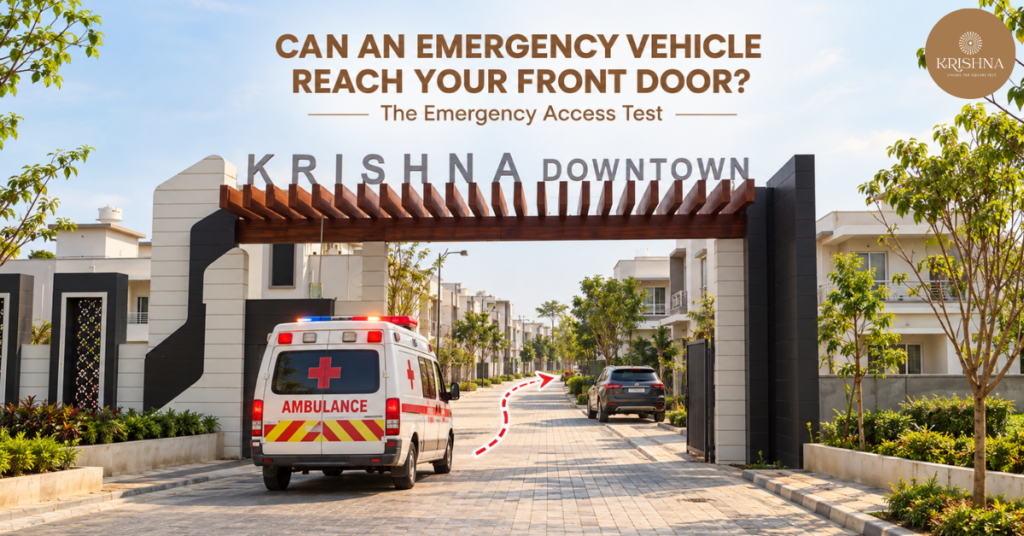
Table of Contents
- Introduction
- Quick Answer: How Do You Check Emergency Vehicle Access Before Buying a Home?
- 1. Start From the Public Road, Not the Villa Entrance
- 2. Test the Gate at Its Narrowest Usable Opening
- 3. Measure Usable Road Width, Not Brochure Road Width
- 4. Find the Tightest Turn and the Dead-End Problem
- 5. Look Up: Overhead Clearance Can Stop a Tall Vehicle
- 6. Check Whether the Road Surface and Drains Remain Usable
- 7. Test the Final Approach: Vehicle Access Is Not the Same as Patient Access
- 8. Ask How Security Behaves During an Emergency
- 9. Check What Happens After People Move In
- 10. Compliance Documents vs On-Ground Reality
- FAQ
Introduction
The signatures are complete. The biometrics are done. The registered sale deed is finally in your name.
For many buyers, this is the moment when the property file is closed, placed in a cupboard and forgotten.
But from an ownership-management point of view, property registration in Odisha is better treated as the start of a short follow-up sequence—not the final administrative step.
The reason is simple: different systems record different parts of your ownership journey. The registration office preserves the registered transaction. The revenue system deals with mutation and RoR. A municipality or other local body may maintain a property-tax or holding record. The electricity distributor maintains the consumer account. Your lender may hold original documents. Your income-tax paperwork may have its own closing steps.
The useful question after registration is therefore not:
“Do I own the property now?”
It is:
“Have all the records that will matter later been updated, checked and safely stored?”
Quick Answer: How Do You Check Emergency Vehicle Access Before Buying a Home?
Walk the route exactly as a fire tender or ambulance would have to use it. Check seven things:
• 1. Public-road approach: Can a larger vehicle reach the project gate without an obvious choke point?
• 2. Gate clearance: What is the narrowest clear opening when the gate or boom barrier is actually operating?
• 3. Usable internal road: How much road remains after realistic parking, visitors and landscaping?
• 4. Tightest turn: Can a larger vehicle negotiate bends, islands, cul-de-sacs or dead ends?
• 5. Overhead clearance: Are there arches, cables, signage, branches or projections above the route?
• 6. Surface and obstruction: Is the route motorable, drained and free of raised covers or permanent obstacles?
• 7. Final approach: Once the vehicle stops, can responders or a stretcher reach the home without avoidable barriers?
The focus keyword here is fire tender access in residential project, but the same route-thinking also helps a buyer evaluate ambulance access and other emergency response movement.
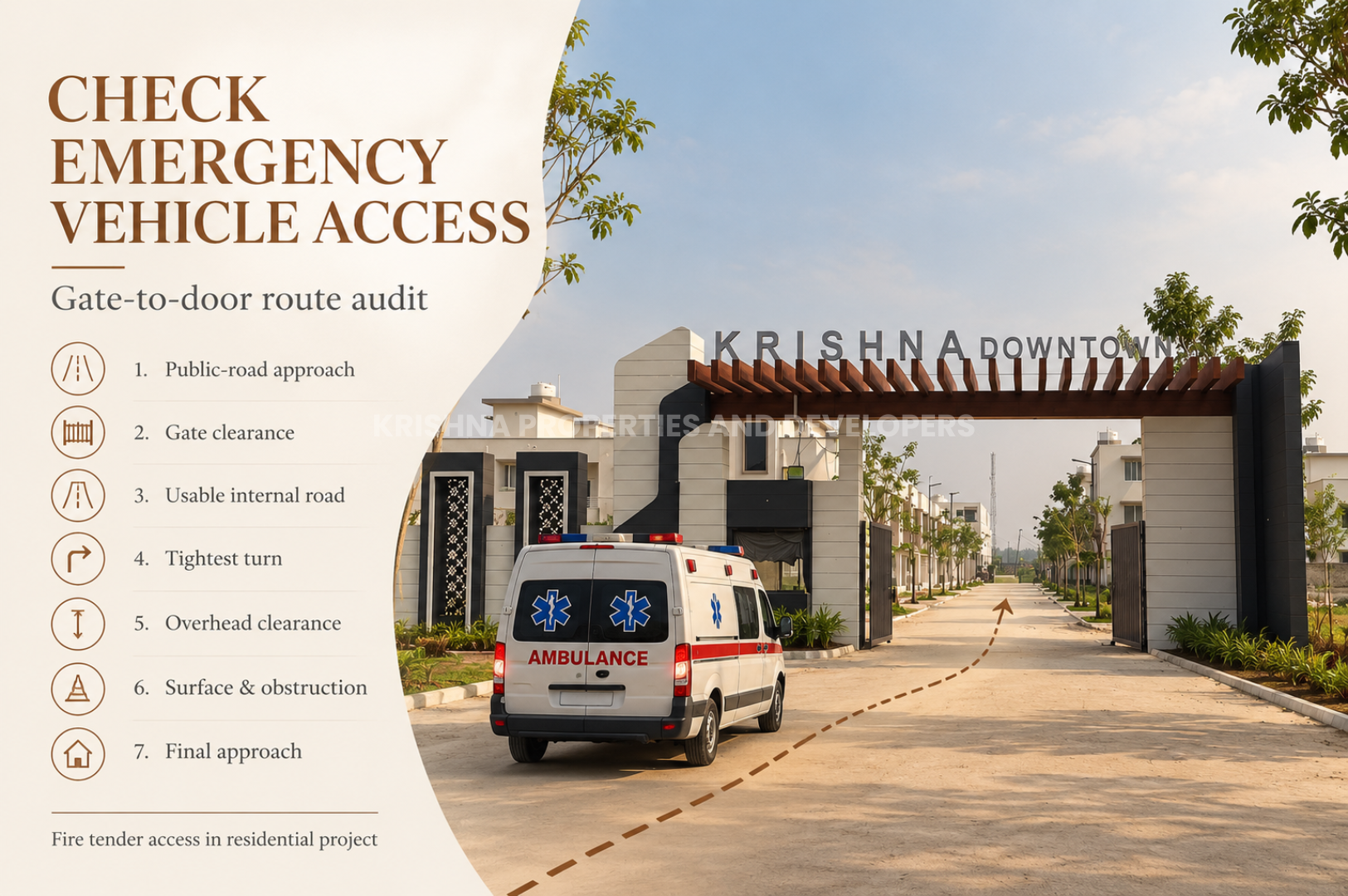
A Homebuyer’s Gate-to-Door Emergency Access Audit
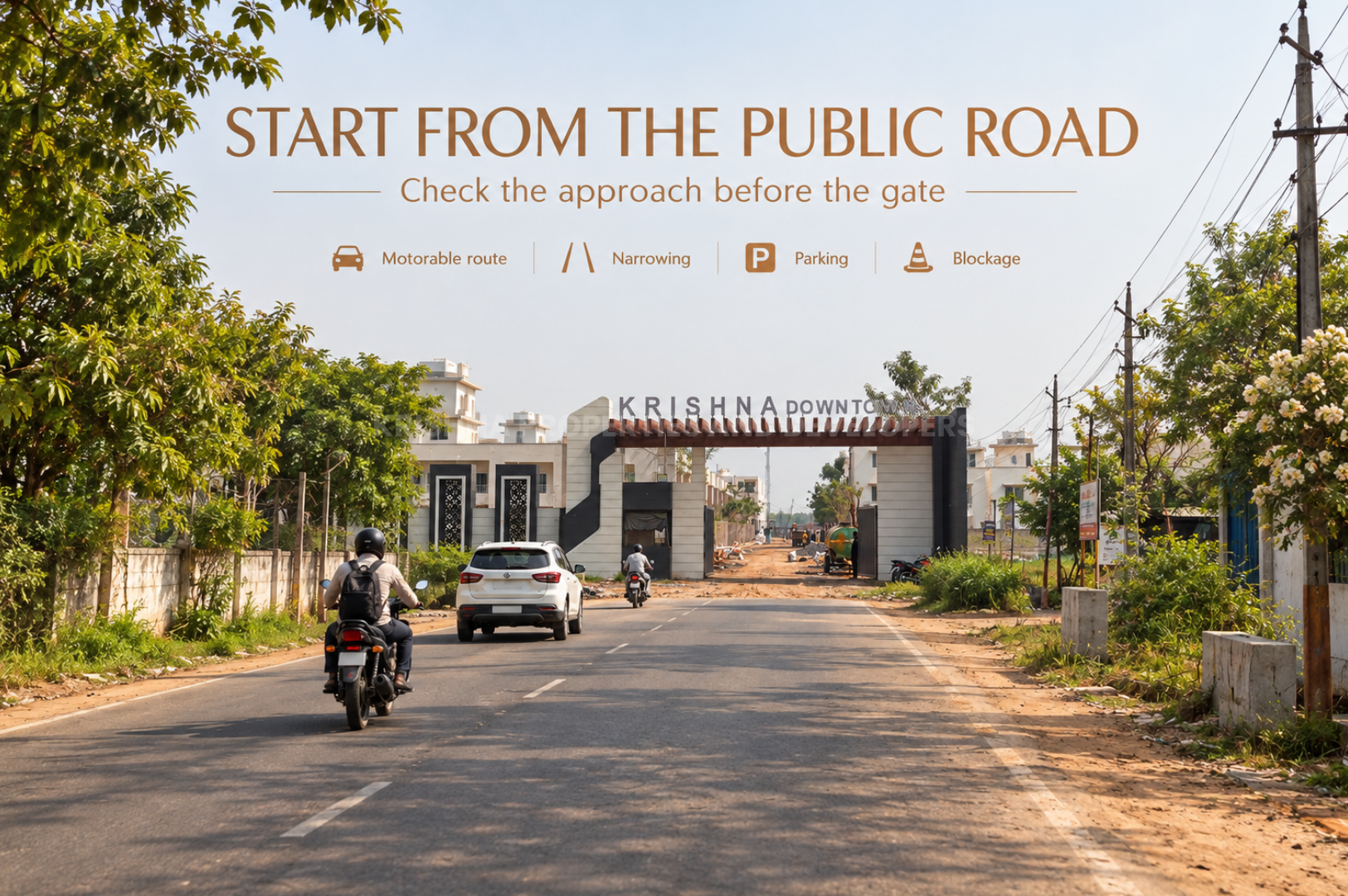
A common site-visit mistake is to begin the inspection after you have already entered the property.
For emergency access, start one step earlier.
Stand on the road outside the project and imagine a vehicle that is longer, taller and less manoeuvrable than your own car.
Ask:
- Is the approach to the project gate continuously motorable?
- Does the route narrow sharply near the entrance?
- Do parked vehicles routinely occupy the edge of the approach?
- Is there a median, sharp turn, market activity or informal parking immediately before the gate?
- Would two vehicles meeting near the entrance create a blockage?
This does not mean a buyer should decide technical compliance by eye. The point is to identify a visible constraint that deserves a question against the approved layout and applicable rules.
2. Test the Gate at Its Narrowest Usable Opening
The entrance is often the first place where brochure width and real-world width become different.
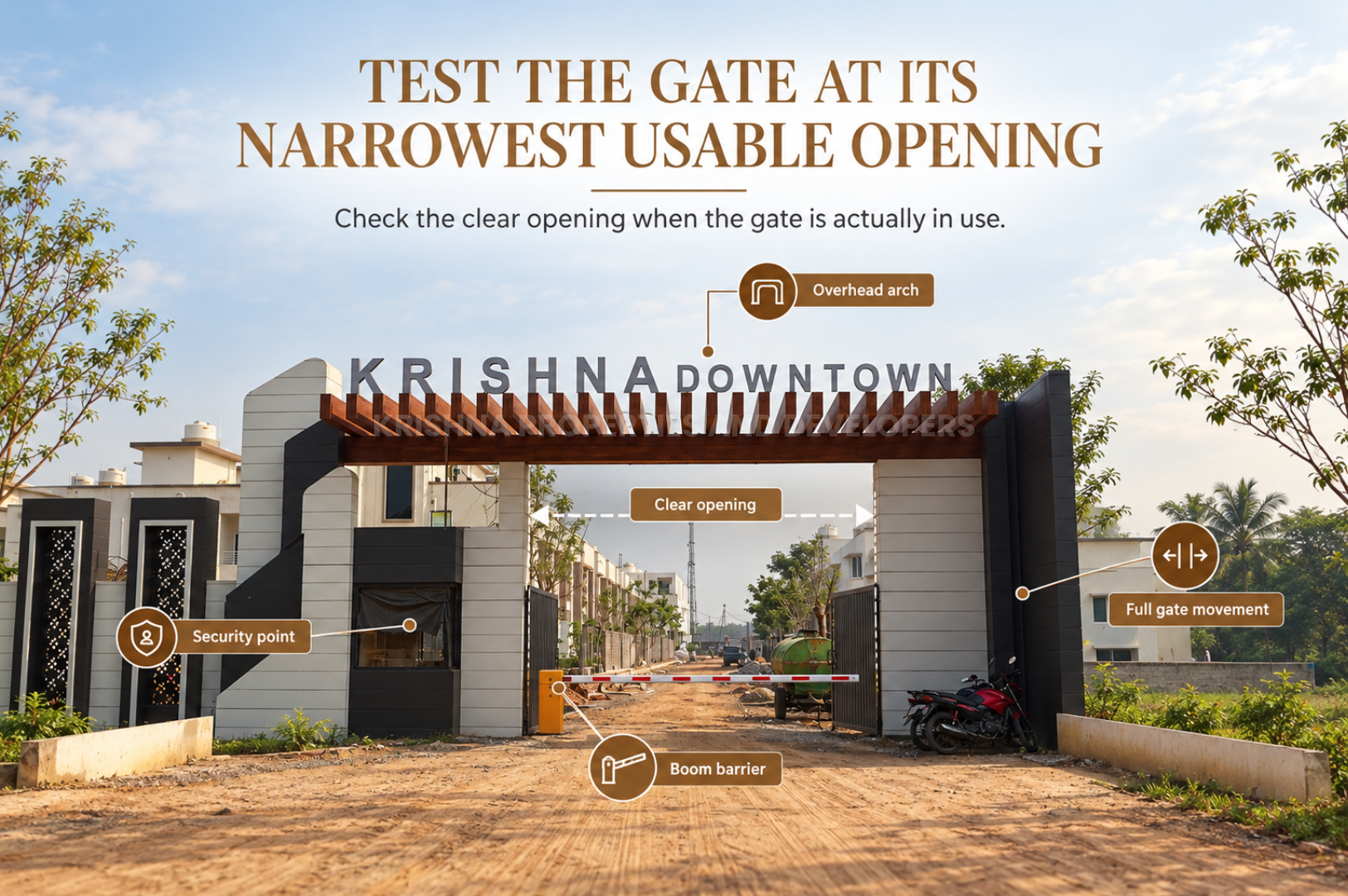
A decorative gate may sit between wide boundary walls, but what matters in an emergency is the clear opening available when the gate is actually used.
Check:
- Does the gate leaf fold or slide completely away from the vehicle path?
- Does a boom barrier reduce manoeuvring space?
- Is there a security island that narrows the entry?
- Are bollards, planters or sign structures positioned inside the gate?
- Is there an overhead arch or signage element?
- Can security open the full route quickly without looking for a special key or manual release?
Odisha’s Development Authorities rules contain specific fire-engine access provisions for certain buildings. For example, the current 2020 rules state a 6 m main entrance in the applicable high-rise provisions, require gates to fold back so the access way remains free, and require clear fire-service movement space. Buyers should not automatically apply those numbers to every low-rise villa project; instead, verify the rules and approved plan that apply to the specific development.
3. Measure Usable Road Width, Not Brochure Road Width
This is the most important practical distinction in the article:
Nominal road width is not always the same as usable emergency width.
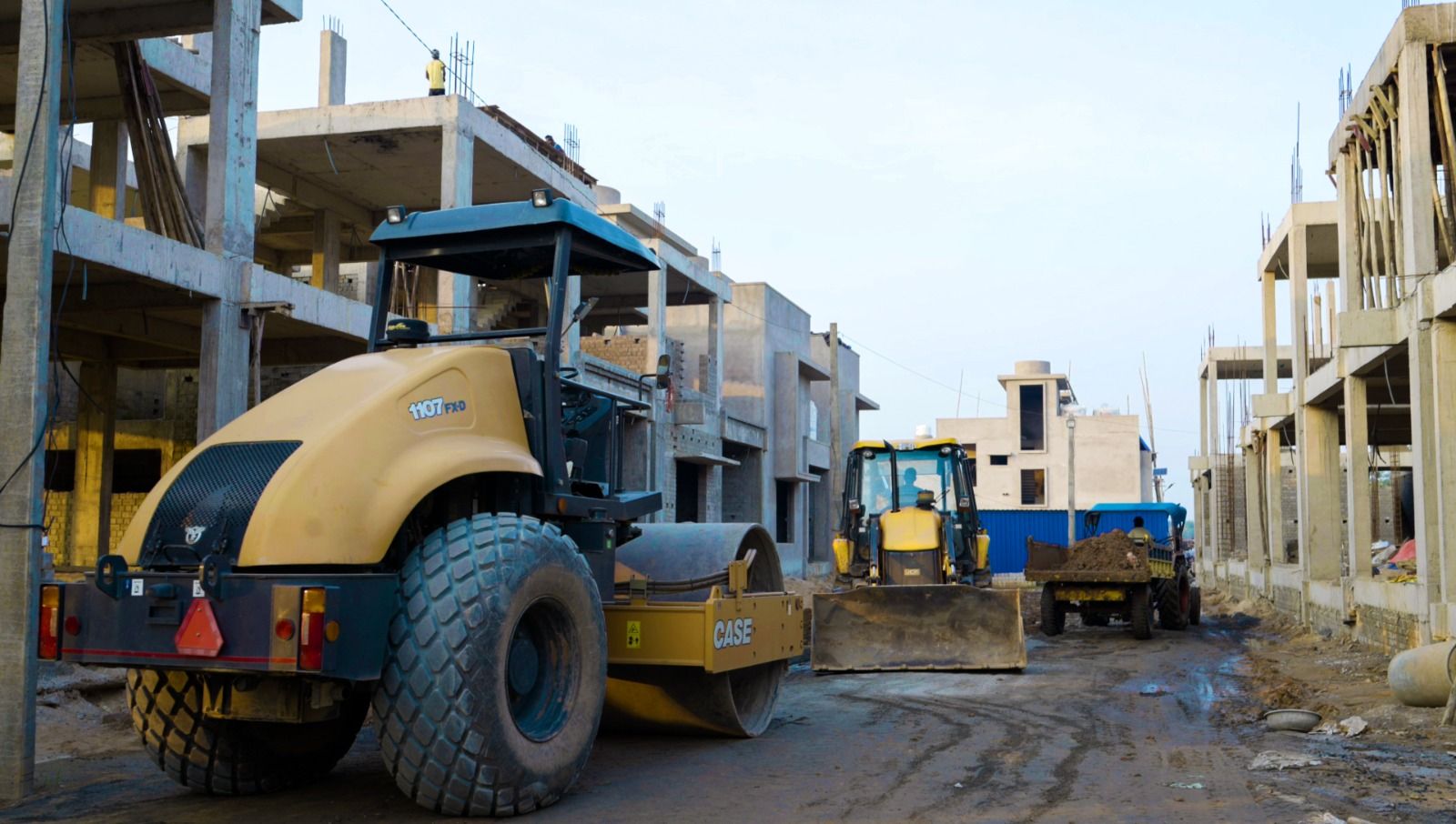
Imagine an internal road shown as 40 feet on a project page. Now add:
- one visitor car parked partly on the carriageway
- two-wheelers near a villa entrance
- a delivery vehicle stopped for three minutes
- a planter or tree guard projecting into the edge
- a drain edge that drivers avoid mounting
- a temporary festival gate or community decoration
The right buyer question becomes:
“How much clear, motorable width remains at the narrowest point on a normal occupied day?”
This is why internal road width in a gated community should be evaluated as an operating condition, not merely as a brochure number.
4. Find the Tightest Turn and the Dead-End Problem
Emergency access can fail even when every straight section of road is generous.
The problem may be the turn.
Walk to the most difficult bend in the community and observe:
- Does a central island reduce the turning path?
- Are cars likely to park near the corner?
- Does landscaping project into the curve?
- Does the road end in a cul-de-sac?
- If it is a dead end, is there enough usable space to turn rather than reverse a long distance?
- Would a second emergency vehicle block the first?
Technical standards use vehicle geometry and turning requirements that buyers should not try to certify themselves. Your job is simpler: identify the tightest geometric point and ask how it is shown in the approved plan and how emergency movement was considered.
5. Look Up: Overhead Clearance Can Stop a Tall Vehicle
Homebuyers naturally look at the road surface. Emergency vehicles also need space above it.
Check the full route for:
- entry arches
- low signage structures
- tree branches
- sagging cables
- balcony or canopy projections near the route
- temporary decorative structures
Odisha’s current Development Authorities rules specifically address archway height in the relevant high-rise entrance provisions. That is a useful reminder that width alone does not define access.
6. Check Whether the Road Surface and Drains Remain Usable
A route can be wide enough and still be difficult to use.
Look for:
- soft or unfinished shoulders
- deep side drains without protected edges
- raised manhole covers
- sharp level changes
- steep ramps
- waterlogging or recurring ponding points
- paving that has visibly settled
Odisha’s planning rules state that applicable access ways should be properly drained and lighted and that fittings within the right of way should remain flush so they do not obstruct safe movement. This is exactly the kind of detail a buyer can understand without pretending to perform a technical certification.
7. Test the Final Approach: Vehicle Access Is Not the Same as Patient Access
An ambulance may be able to enter the community and still stop far from the person who needs help.
So complete the route.
From the most realistic ambulance stopping point, walk to the front door and ask:
- Are there steps before the entrance?
- Is there a narrow pedestrian gate?
- Would a stretcher have to negotiate a sharp turn?
- Could parked vehicles block the final approach?
- Is the house number clearly visible from the internal road?
- At night, is the route easy to identify?
For households with senior parents, mobility limitations or young children, this final segment can be as important as the ambulance access to the residential project itself.
9. Check What Happens After People Move In
A newly completed project is usually at its easiest to navigate.
The more revealing question is what happens after full occupation.
Ask whether the community has a plan to keep emergency routes free from:
- visitor parking
- resident overflow parking
- commercial deliveries
- temporary event structures
- movable planters
- waste-collection vehicles
- future landscaping changes
A road that is compliant on a drawing but routinely narrowed by everyday use may not perform the way a buyer assumes.
That is why emergency access is partly a design question and partly a management question.
8. Ask How Security Behaves During an Emergency
A controlled gate is useful for everyday security. During an emergency, the operating procedure matters just as much as the physical gate.
Ask the project or facility team:
- How is an ambulance or fire vehicle identified and admitted?
- Can the full gate be opened immediately?
- What happens during a power outage?
- Is there a manual override for powered gates or barriers?
- Can security guide responders directly to the correct villa?
- Is there a current emergency contact/escalation process?
The Odisha Fire & Emergency Services website currently lists 112 as the emergency call number. A residential community should also know how an incoming responder is guided once they reach the gate.
10. Compliance Documents vs On-Ground Reality
The final step is not a government form. It is information management.
Create one permanent property document file with the same folder structure in physical and digital form.
Folder | What to Store |
01 · Registration | Registered deed, registration reference, fee/stamp records, certified copies |
02 · Revenue | Mutation reference/order, RoR Odisha, Bhulekh extracts/maps |
03 · Tax / Local Body | Holding/property assessment, ownership update, tax receipts |
04 · Utilities | Electricity name-transfer record, water/other service records where applicable |
05 · Loan / Income Tax | Loan papers, document inventory, current TDS/challan/statement records where applicable |
06 · Project / Handover | Possession letter, handover sheet, warranties, approvals/documents supplied to buyer |
07 · Maintenance | Maintenance receipts, association/RWA documents, service records |
08 · Evidence | Property photographs at handover, meter readings, key correspondence |
FAQs
What should I check about fire tender access before buying a home?
Check the entire route from the public road to the building/home: entrance gate, clear internal road, tightest turn, overhead clearance, road surface, parking obstructions and the final responder approach. Also review the approved/current project information and applicable fire-safety requirements.
Is a wide internal road enough to guarantee emergency access?
No. A generous nominal road width can still be reduced by parked cars, gate islands, landscaping, tight bends, dead ends or overhead obstructions. The usable route matters.
Is ambulance access the same as fire tender access?
Not exactly. Both need reliable vehicular access, but an ambulance audit should also consider where the vehicle can stop and whether responders or a stretcher can move from that point to the front door.
What is the minimum road width for a fire engine in Odisha?
Do not apply one number to every residential project. Odisha rules contain specific access provisions for particular building categories, especially high-rise/fire-safety cases. Verify the current rules, approved plan and competent authority requirements for the exact project.
Do residential projects in Odisha need a Fire Safety Certificate?
Odisha Fire & Emergency Services states that residential buildings 15 metres and above fall within the categories requiring Fire Safety Recommendation/Certificate processes. Applicability depends on the specific building/premises category.
Should I check emergency access even in a villa community?
Yes. Low-rise living changes the building type, but buyers can still benefit from checking how an ambulance, fire vehicle or other emergency responder would move through the gate and internal roads to the home.
What should I ask the developer during a site visit?
Ask to see the current project/layout information relevant to access, the route intended for emergency vehicles, how the gate is opened, how parking is controlled, and which fire-safety approvals apply to the project.
What should I check at Krishna Downtown?
The current official project page lists 40-feet internal roads. If the project is on your shortlist, ask Krishna Properties and Developer to show the current route and phase-specific project information, then walk the narrowest gate/turn/final approach yourself. Do not treat the road-width number alone as a complete emergency-access assessment.

Krishna Developers
Planning to buy a villa near Bhubaneswar?
- Explore Krishna Downtown, Phulnakhara, a premium gated villa community designed for families who value space, peace, greenery, and connectivity.
- Connect with the Krishna Developers team to understand project details, location advantages, RERA information, and site visit options.