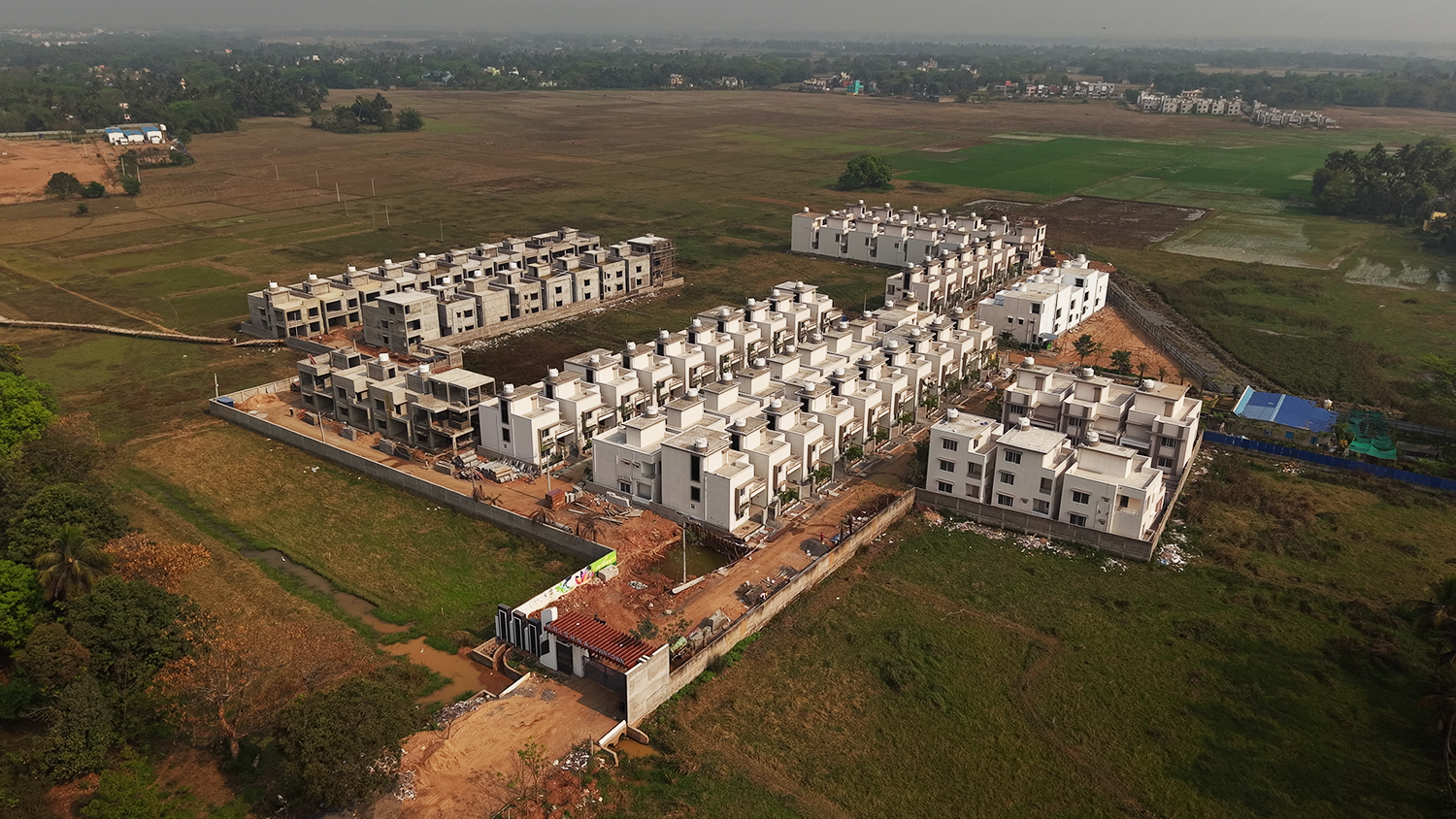

The Sound Test: How to Evaluate Noise Before Buying a Home
Table of Contents
- Introduction
- Quick Answer: How Do You Check Noise Before Buying a House?
- Why “Peaceful” Is Not a Property Specification
- Step 1 — Build a Sound-Source Map Before You Enter
- Step 2 — Do a Two-Minute Silence Test Inside the Exact Room
- Step 3 — Run the Open-vs-Closed Window Test
- Step 4 — Separate Background Hum From Sound Spikes
- Step 5 — Test the Bedroom From Pillow Position
- Step 6 — Test the WFH / Study Seat
- Step 7 — Listen for the Community’s Own Mechanical and Amenity Noise
- Step 8 — Repeat the Test at the Time That Matters to Your Family
- What Do India’s 55 dB(A) Day / 45 dB(A) Night Standards Actually Mean?
- Can a Smartphone Sound Meter App Help?
- FAQ
Introduction
- What is producing the sound?
- How is that sound reaching the home?
- Which room receives it?
- Does it happen when your family needs that room to be quiet?
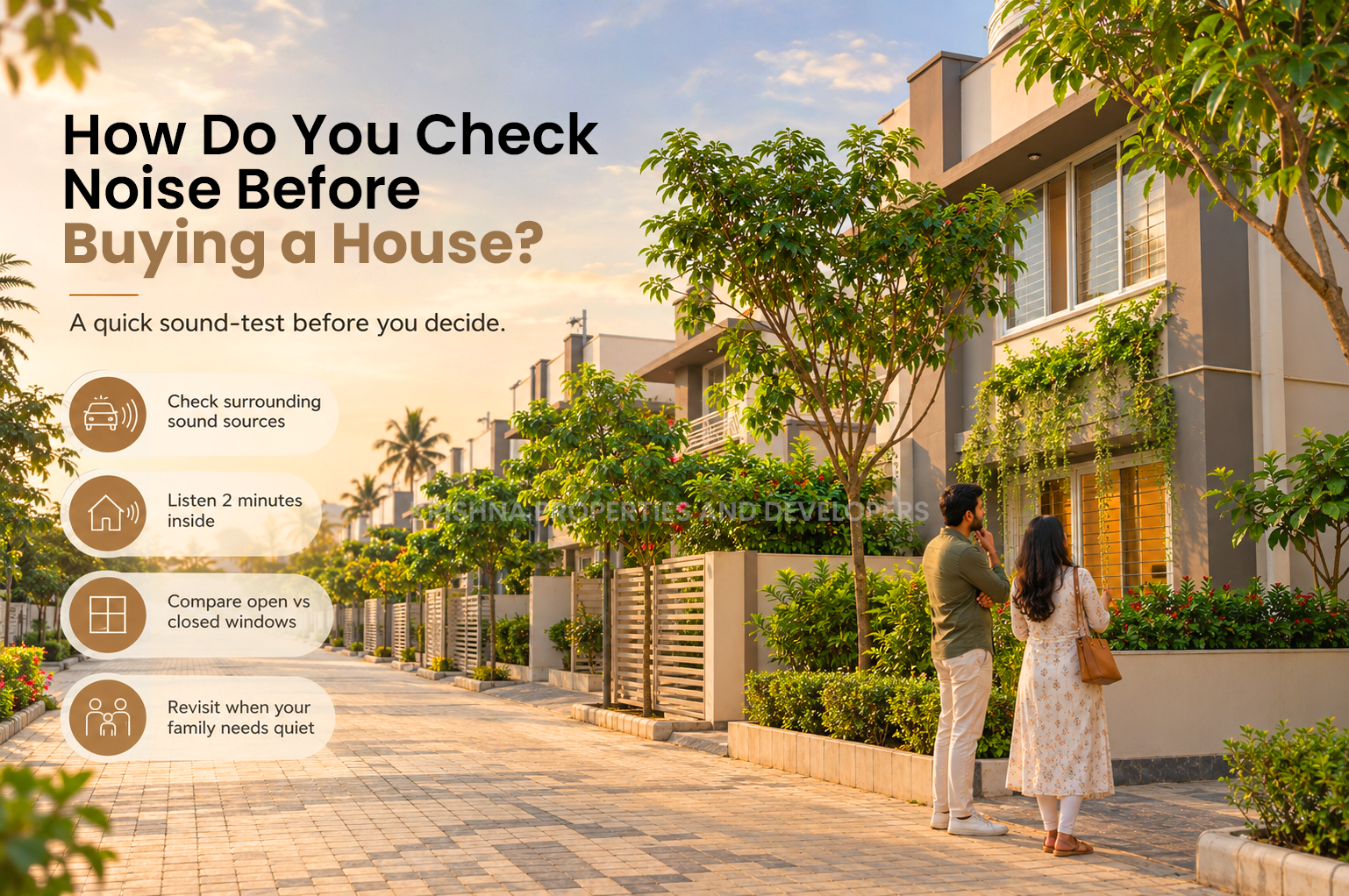
Quick Answer: How Do You Check Noise Before Buying a House?
- Walk the surrounding roads and identify the main sound sources before entering.
- Stand silently inside the exact bedroom/living room for two uninterrupted minutes.
- Compare the room with windows open and fully closed.
- Separate continuous background hum from short but disruptive sound spikes.
- Listen from the pillow position, not only from the centre of the bedroom.
- Sit where the WFH desk or study table is likely to go.
- Check community-generated sounds: gates, pumps, DG sets, sports/play areas and gathering spaces.
- Return at the time your family most needs quiet—rather than relying on one convenient sales visit.
If a single visit leaves you uncertain, the right next step is not an argument about whether the location is “peaceful.” It is a second visit targeted at the uncertainty.
Why “Peaceful” Is Not a Property Specification
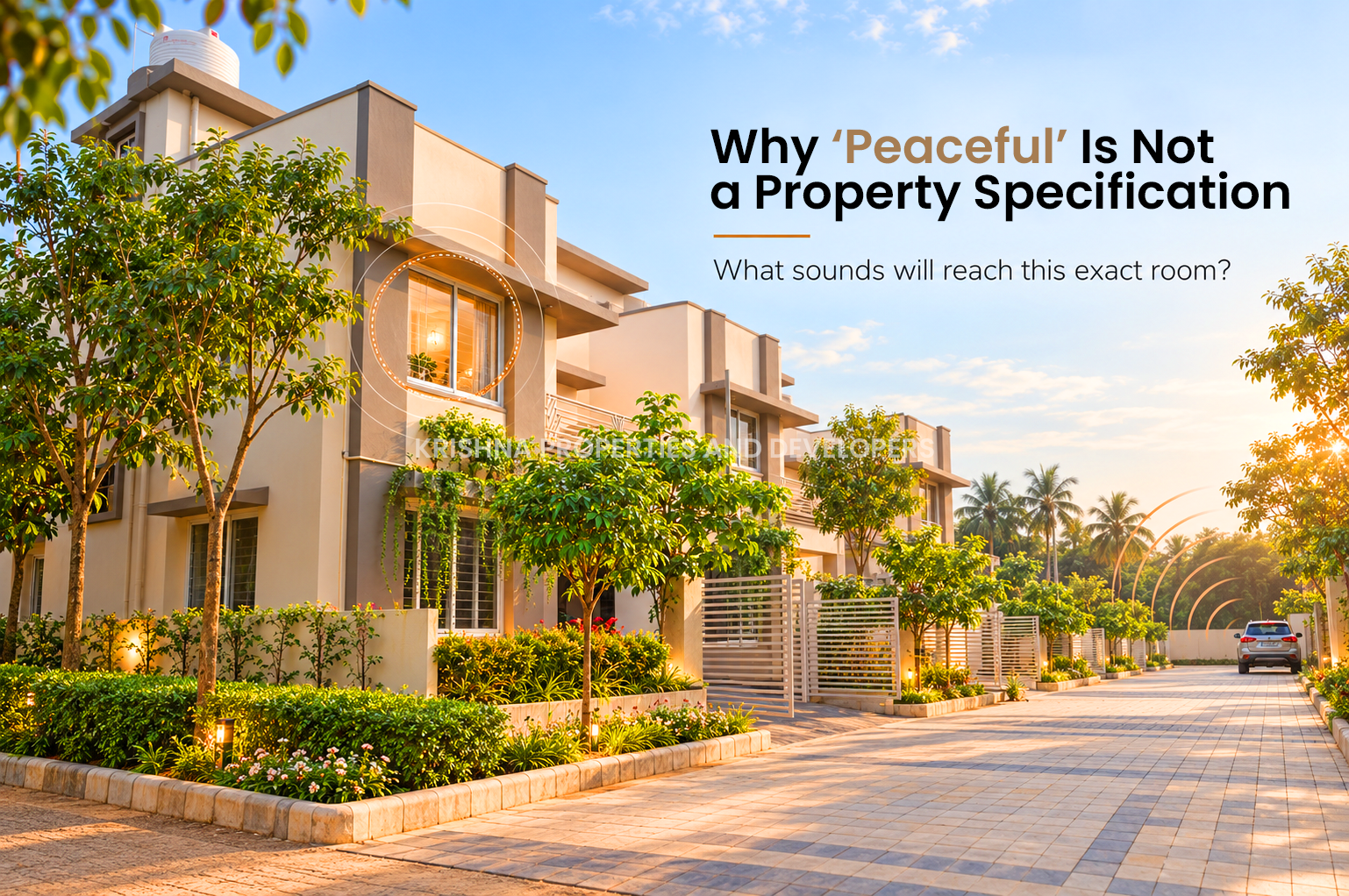
Words such as peaceful, serene, calm and away from city noise are common in property marketing. They are impressions, not acoustic specifications.
Two villas in the same community can experience different sound conditions because one faces an approach road, another faces a park, one sits near a gate, and another sits near a recreational or service zone. The same room can also feel different with a window open, a window closed, curtains installed, or future buildings added around the site.
So do not ask only:
“Is this a quiet project?”
Ask instead:
“What sounds will reach this exact room, at the hours we will actually use it?”
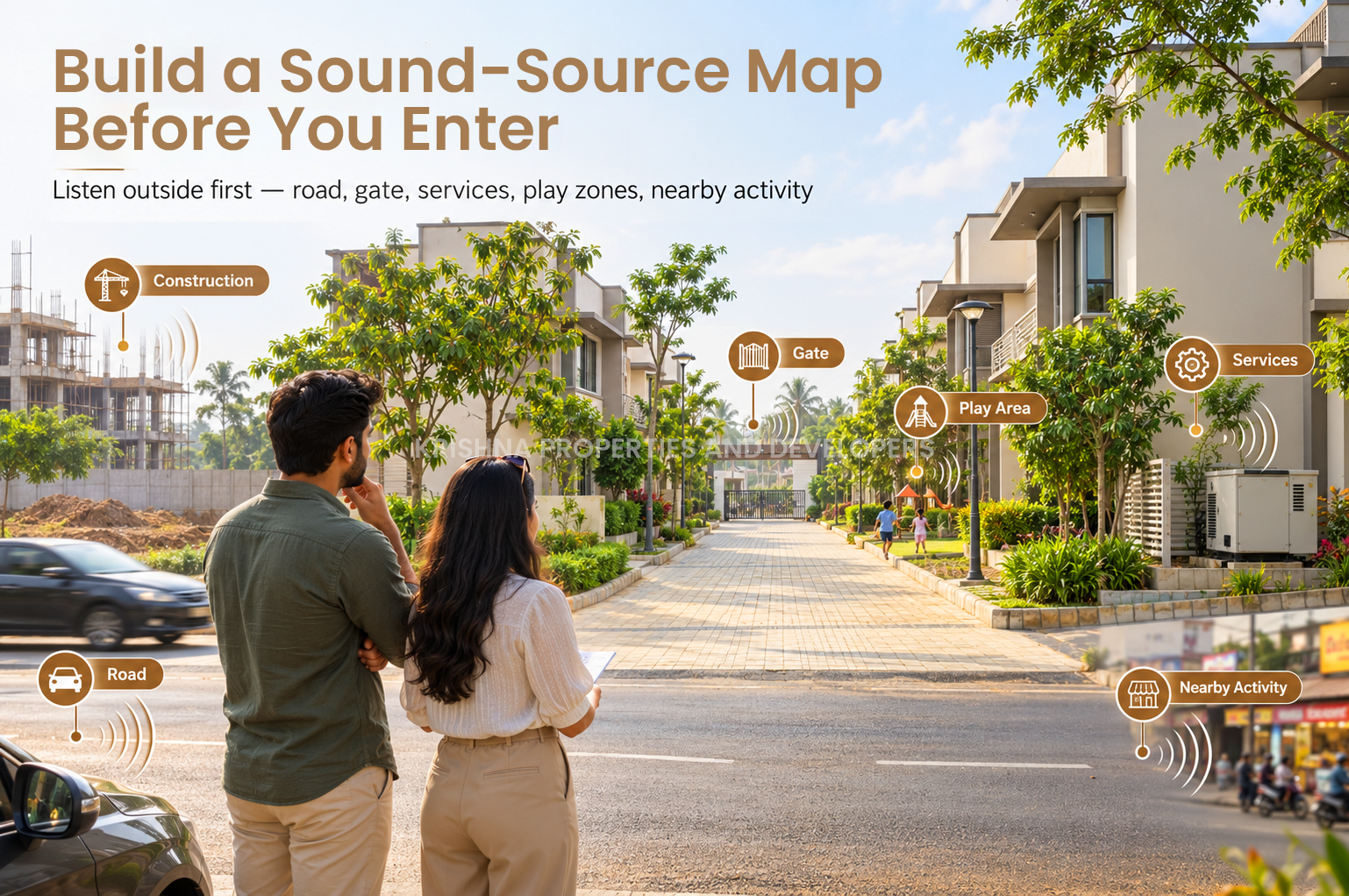
Step 1 — Build a Sound-Source Map Before You Enter
Before walking into the home, stand outside and listen in four directions. Your goal is to make a simple noise-source map.
| Possible Source | What to Notice | Why Timing Matters |
| Main / service road | Traffic flow, horns, acceleration, braking, heavy vehicles | Rush hour and late-night vehicle mix may differ |
| Internal road / gate | Visitor vehicles, security conversations, horn use, deliveries | Morning/evening peaks may be stronger |
| Construction / vacant plot | Machinery, cutting, drilling, trucks | Temporary today, but future use of adjoining land may matter |
| Generator / pump / service equipment | Low hum, vibration, start-stop cycles | May appear only during outages or pumping cycles |
| Play / sports / clubhouse / banquet zone | Voices, whistles, music, gatherings | Weekend/evening pattern may differ |
| Commercial / public activity nearby | Loading, public-address sound, crowds | May be highly schedule-dependent |
Do not label every sound as a problem. A children’s play area, for example, is a valuable amenity for many families. The buyer question is whether the location of the home relative to that sound source suits your own routine.
Step 2 — Do a Two-Minute Silence Test Inside the Exact Room
Most site visits are full of conversation. That makes sound assessment almost impossible.
Ask everyone to stop talking for two minutes. Switch off the television or music if it is running. Do not turn off equipment you are not authorised to operate.
During those two minutes, record what you can actually hear:
- constant road hum
- individual horns
- voices from outside
- pumps or motors
- construction activity
- dogs or community activity
- other mechanical humming
- periods of genuine quiet between events
Then repeat the same silence test in the bedroom, because a living room can tolerate sounds that become frustrating during sleep.
Step 3 — Run the Open-vs-Closed Window Test
One of the most practical traffic noise home tests requires no technical equipment.
Listen for one minute with the relevant window open. Then close it completely and listen again from the same position.
Do not ask only, “Did it become quieter?” Ask:
- Which sounds reduced significantly?
- Which sounds remained almost unchanged?
- Can you hear leakage around the frame or door?
- Does closing the window make the room usable for sleep or calls?
- If you need the window open for ventilation, what sound environment do you actually get?
This last question matters. A buyer should not solve one comfort issue by unknowingly creating another. If a room is comfortable only with windows shut and mechanical cooling running, that may still be acceptable—but it should be an informed choice, not a surprise after possession.
Do not conclude that a specific glass type or frame is “soundproof” merely from a short visit. Acoustic performance depends on the complete façade system, installation, gaps, ventilation openings and sound frequency—not just the marketing name of the window.
Step 4 — Separate Background Hum From Sound Spikes
A single “average noise” description can hide the difference between two very different homes.
Home A may have a steady background traffic hum. Home B may be quiet most of the time but experience a loud horn, reversing alarm or heavy-vehicle pass every few minutes.
For daily comfort, frequency and predictability matter alongside loudness.
| Pattern | What It Feels Like | What the Buyer Should Record |
| Continuous | Steady road / equipment hum | How noticeable it is with windows open and closed |
| Intermittent spikes | Horns, gates, alarms, vehicle acceleration | How often; what time; which room |
| Scheduled | School, sports, events, waste pickup, deliveries | Days and times |
| Occasional / seasonal | Construction phase, festivals, temporary activity | Whether temporary or likely to recur |
| Low-frequency / vibration | Generator, large vehicle, equipment rumble | Whether heard, felt, or both |
This becomes your Silence-to-Spike Diary. It is more useful than writing “noise level okay.”
Step 5 — Test the Bedroom From Pillow Position
The centre of a bedroom is not where you sleep.
Stand or sit where the head of the bed is likely to be. Then listen with the windows closed and open.
Check whether that position is closest to:
- a road-facing window
- an external gate or internal road
- a shared service wall
- a pump or equipment room
- a community/recreational zone
- a future adjoining plot
Then ask whether the bed can realistically be moved to another wall without compromising wardrobe access, doors or room circulation.
A “quiet home” decision becomes much more precise when it is tied to the exact sleeping position rather than a general impression of the bedroom.
Step 6 — Test the WFH / Study Seat
A sound pattern that does not disturb sleep may still make video calls or focused study difficult.
Sit where a desk is likely to go. Stay there for several minutes and listen for:
- horn peaks that interrupt calls
- voices from a common area
- pump or equipment cycles
- construction sound
- echo within an empty room
- road-facing window noise
Empty demonstration homes often sound more reflective because there are fewer soft furnishings. Rugs, curtains, sofas and beds can reduce room echo, but they do not necessarily stop outside sound entering through weak façade points.
So distinguish between echo inside the room and noise entering the room. They are different problems.
Step 7 — Listen for the Community’s Own Mechanical and Amenity Noise
External roads are only one source.
In a planned residential community, also locate the relationship between the home and:
• DG / backup equipment
• water pumps or utility rooms
• entrance and security point
• clubhouse or banquet space
• children’s play area
• sports court or box cricket zone
• car-wash/service area
• waste pickup / service route
None of these facilities should automatically be treated as negative. Many add real lifestyle value.
The buyer’s job is to understand distance, orientation, operating schedule and room exposure.
A family with young children may deliberately prefer a home near the play area. A family with a light sleeper working night shifts may make a different choice. The “best” location inside a community depends partly on the family’s sound sensitivity and routine.
Step 8 — Repeat the Test at the Time That Matters to Your Family
This is where the Sound Test deliberately differs from a generic evening neighbourhood inspection.
Do not collect random visits. Choose a second time because it answers a specific question.
| Family Concern | Useful Repeat-Visit Window | Question to Answer |
| School / office commute noise | Weekday morning peak | Does traffic/horn activity reach the bedrooms or living room? |
| Evening family time | Weekday evening | Does road/community activity affect living-room or outdoor use? |
| Sleep | Late evening where safe and practical | What remains audible after daytime activity falls? |
| WFH | Typical work-call hours | Are recurring sound spikes likely to interrupt calls? |
| Weekend recreation | Weekend afternoon/evening | How do community/nearby leisure activities change the soundscape? |
One quiet Sunday morning should not become proof that a property is always quiet. One noisy festival evening should not become proof that it is always noisy either.
You are looking for the normal pattern that overlaps your family’s routine.
What Do India’s 55 dB(A) Day / 45 dB(A) Night Standards Actually Mean?
The final step is not a government form. It is information management.
Create one permanent property document file with the same folder structure in physical and digital form.
Folder | What to Store |
01 · Registration | Registered deed, registration reference, fee/stamp records, certified copies |
02 · Revenue | Mutation reference/order, RoR Odisha, Bhulekh extracts/maps |
03 · Tax / Local Body | Holding/property assessment, ownership update, tax receipts |
04 · Utilities | Electricity name-transfer record, water/other service records where applicable |
05 · Loan / Income Tax | Loan papers, document inventory, current TDS/challan/statement records where applicable |
06 · Project / Handover | Possession letter, handover sheet, warranties, approvals/documents supplied to buyer |
07 · Maintenance | Maintenance receipts, association/RWA documents, service records |
08 · Evidence | Property photographs at handover, meter readings, key correspondence |
Can a Smartphone Sound Meter App Help?
Yes—but use it for the right purpose.
A phone can help you compare the same room under different conditions: window open vs closed, morning vs evening, road-facing bedroom vs rear bedroom.
It should not be treated automatically as a legal or compliance instrument.
NIOSH research has shown that some tested smartphone configurations can perform reasonably well under controlled conditions, but app/device accuracy varies; NIOSH also states that its app is not a replacement for a professional sound level meter for compliance purposes.
For a buyer, the best use is comparative:
- Use the same phone and same app for all comparisons.
- Hold the phone in roughly the same position.
- Compare similar durations—not a one-second peak against a two-minute average.
- Record context: time, window position, room, traffic condition.
- If noise is a major decision factor, consider a competent acoustic professional rather than relying only on an app.
The Sound Path Audit
Use this table during the site visit. The point is not to produce an “acoustic score” that pretends to be scientific. It is to make your observations traceable.
| Audit Point | What to Check | Your Evidence |
| Source | Road, gate, equipment, construction, amenity, public activity | Photo/map note + time |
| Path | Open window, closed window, door, façade, open balcony, internal route | Open/closed comparison |
| Room | Bedroom, study, living, kitchen, outdoor sit-out | Two-minute silence observation |
| Use point | Pillow, desk, sofa, dining, balcony chair | Listen from actual position |
| Pattern | Continuous, spike, scheduled, occasional, low-frequency | Sound diary |
| Timing | Morning, work hours, evening, night, weekend | Repeat visit if needed |
| Future change | Vacant plot, planned road, construction, future community use | Ask + verify current planning information |
| Decision | Acceptable / needs clarification / needs second visit / major concern | Family-specific decision |
A Simple 10-Minute Sound Diary
| Minute | What Happened? | Room / Window | Impact on Family Use |
| 0–2 | Baseline silence test | Bedroom / closed | Sleep? |
| 2–4 | Window open comparison | Bedroom / open | Ventilation vs noise trade-off? |
| 4–6 | Desk / study position | Study / living | Calls / concentration? |
| 6–8 | Outdoor/balcony or sit-out | Outdoor edge | Relaxation / conversation? |
| 8–10 | Walk towards gate/service/amenity side | Community route | Source confirmation? |
If ten minutes does not capture the source you are worried about, do not extend the visit indefinitely. Return at the time the source is expected to occur.
How to Apply the Sound Test in Phulnakhara and Near Bhubaneswar
For families considering a villa in Phulnakhara or a home near Bhubaneswar, sound should be assessed at the exact property—not inferred from broad statements such as “outside the city” or “near the highway.”
The wider Bhubaneswar-Cuttack side can contain very different acoustic conditions within short distances: arterial traffic, internal neighbourhood roads, construction, open land, commercial pockets and quieter residential stretches can all produce different sound patterns.
If Krishna Downtown is part of your shortlist, apply the same audit rather than relying on marketing language about calm living.
The official project site currently lists shared amenities including a clubhouse, banquet hall, children’s play area, box cricket, multipurpose court, swimming pool and walking track. Those are lifestyle features—not noise problems by definition. But a serious buyer can still ask where the exact villa sits in relation to those spaces, the entrance, service equipment and internal roads.
Ask the Krishna Properties and Developer team to help identify the current layout/location of the exact villa or configuration you are evaluating. Then perform the Sound Path Audit on site.
Do not publish or assume project-specific claims such as indoor decibel levels, “soundproof” construction, acoustic glass performance or guaranteed quietness unless supported by current technical documentation or competent testing.
Conclusion: Buy the Soundscape, Not Just the Floor Plan
A home is not only a visual environment.
It has a daily soundscape.
Morning traffic can reach one bedroom but not another. A window can transform outside noise when closed but create a ventilation trade-off when open. An amenity can be a family benefit for one household and a location consideration for another. A quiet ten-minute visit can miss a recurring sound that appears every evening.
So before you decide that a home is “peaceful,” stop talking and listen.
Find the source.
Trace the path.
Test the room.
Stand where your family will actually sleep, study or work.
Then return at the one time that can prove or disprove your biggest uncertainty.
A brochure can show you how a home looks on the day you visit. A good noise check before buying a house helps you imagine how it may feel on an ordinary Tuesday night five years later.
FAQs
What is the best time to check noise before buying a house?
There is no single best time. Visit when the sound source most relevant to your family is likely to occur. A weekday rush hour may reveal traffic; typical work hours may matter for WFH; late evening may matter for sleep. The second visit should answer a specific uncertainty.
What are the residential noise limits in India?
Under India’s Noise Pollution Rules, residential ambient limits are 55 dB(A) Leq during daytime (6 AM–10 PM) and 45 dB(A) Leq during nighttime (10 PM–6 AM). These are ambient zone standards and should not be treated as a one-second indoor phone-reading pass/fail test.
Can I use a phone app to measure property noise?
A smartphone app can help compare the same room under different conditions, but device/app accuracy varies. It should not automatically be used for legal compliance. If noise is a major issue, consider competent professional measurement.
Should I avoid a home near a main road?
Not automatically. Evaluate distance, orientation, room placement, window/façade performance, road use at relevant times and your family’s tolerance. A road-facing living room and a road-facing bedroom can have very different consequences.
Does closing the window solve traffic noise?
Sometimes it reduces noise significantly, but the result depends on the full window/façade system and installation. Also consider whether your family expects to keep windows open for ventilation during parts of the day.
Can amenities create noise inside a gated community?
Amenities can create normal community activity at particular times. The useful question is how the exact home is positioned relative to play, sports, clubhouse, banquet, gate and service zones, and whether that pattern suits your family.
How do I check noise at Krishna Downtown?
If Krishna Downtown is on your shortlist, ask Krishna Properties and Developer to identify the exact villa’s relationship to internal roads, entrance, amenities and service areas. Then perform the same Sound Path Audit; do not rely only on a general “peaceful living” claim.
Should noise affect my buying decision?
It should be one part of the overall livability decision. Consider sleep, work, study, ventilation preferences, outdoor-space use, family sensitivity, location benefits and whether the sound pattern is acceptable to you.

Krishna Developers
Planning to buy a villa near Bhubaneswar?
- Explore Krishna Downtown, Phulnakhara, a premium gated villa community designed for families who value space, peace, greenery, and connectivity.
- Connect with the Krishna Developers team to understand project details, location advantages, RERA information, and site visit options.